Security Operations Center (SOC): A Comprehensive Guide for 2026 | Building and Implementation

Introduction: Why Every Company Needs a SOC in 2025?
The contemporary cybersecurity threat landscape has transformed into a dynamic jungle where traditional defensive approaches are no longer effective. Digital transformation, cloud computing, remote work, the Internet of Things (IoT), and complex supply chains have scattered the boundaries of traditional IT infrastructure. The classic "castle and moat" approach—where the firewall constituted the perimeter and we sat safely inside—has proven insufficient against modern threats.
The answer to this reality is the Security Operations Center (SOC)—a centralized operational structure serving as the foundation of a modern defense strategy. A SOC is a complex ecosystem where people, processes, and technologies are interwoven into a single organism aiming to ensure continuous visibility, detection, and response to incidents in real-time, 24/7/365.
In this article, I will present a comprehensive picture of a modern SOC—from team architecture and analyst psychology, through technical details, to the regulatory requirements of the NIS2 directive and a vision of a future based on artificial intelligence.
Part I: Foundations – What is a SOC and Why Can't We Function Without It?
Definition and Mission of a SOC
A Security Operations Center is a physical or virtual location where a team of cybersecurity experts continuously monitors, detects, analyzes, and responds to security incidents. A SOC is not merely a "fire brigade" putting out fires that have already started. Modern centers are evolving into proactive risk management hubs, utilizing advanced analytics and Cyber Threat Intelligence (CTI) to predict attacks before the adversary executes the first command.
SOC vs. NOC: Key Differences
A common mistake is confusing a SOC with a NOC (Network Operations Center). The difference is fundamental:
- NOC focuses on infrastructure availability and performance. It ensures the network runs fast and servers are accessible (uptime).
- SOC is tasked with detecting and neutralizing threats. It focuses on identifying anomalies, hostile actions, and breaches threatening the confidentiality, integrity, or availability of data.
SOC as an Element of Business Continuity
In light of the increasing aggressiveness of cybercriminals and regulations like NIS2, the SOC is becoming a key element of Business Continuity. Without it, in the event of a ransomware attack or a serious breach, an organization may simply cease to function. A SOC is no longer a luxury reserved for the largest banks, but an essential survival element for every digital organization.
Part II: The Biggest Threat – The Human Factor and Burnout Crisis
Paradoxically, the greatest threat to SOC effectiveness is not a lack of technology, but the burnout of analysts standing on the front lines of defense. You can own the most expensive software in the world, but without qualified and motivated people, it is just an expensive screensaver.
Team Architecture: The Tier-Based Model
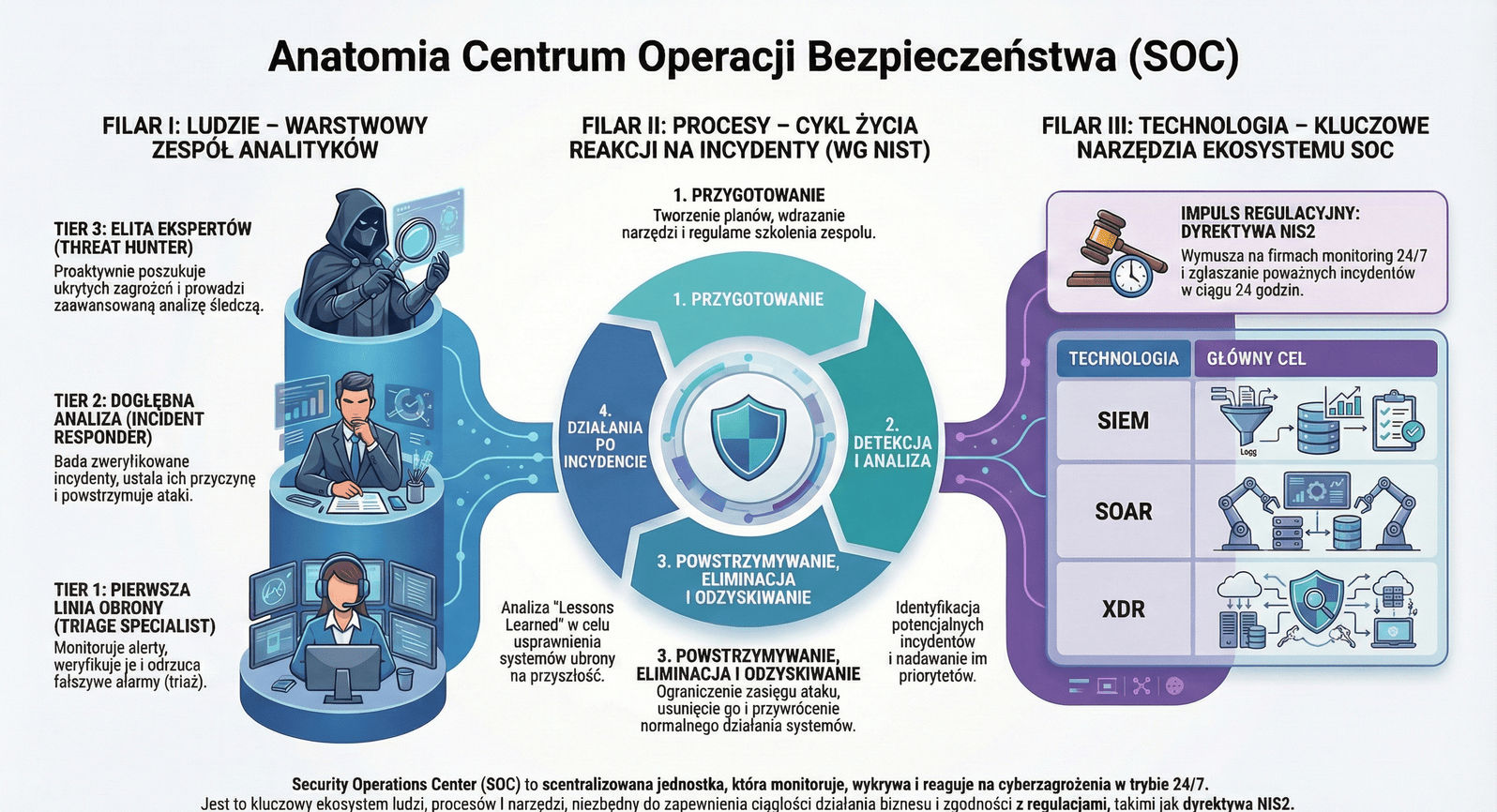
The organizational structure of a SOC is typically based on a Tier-Based Model, which allows for managing the chaos of thousands of daily alerts through a division of responsibility and incident escalation.
Tier 1: Triage Specialist – The Front Line
This is where every alert generated by monitoring systems lands. Tier 1 analysts constitute the "infantry" of cybersecurity.
Tasks:
- Continuous monitoring of the SIEM console
- Initial selection (triage) of alerts – instant assessment of whether an alarm is a false positive or a real threat
- Strict adherence to defined procedures (playbooks)
Challenges:
- Highly repetitive and monotonous work
- Immense time pressure
- Little room for creativity
Biggest Risk: Alert Fatigue
The key threat is the phenomenon of "alert fatigue." Analysts bombarded with thousands of notifications daily, most of which turn out to be irrelevant, lose vigilance. This dramatically increases the risk of overlooking that one critical incident that could paralyze the entire organization.
Tier 2: Incident Responder – The Detectives
When Tier 1 determines that something requires deeper analysis, the incident is escalated to Tier 2. These specialists possess deeper technical knowledge and greater autonomy.
Tasks:
- Correlation of data from various sources (firewall logs, EDR, user data)
- Root Cause Analysis (RCA)
- Reconstruction of the attack timeline
Actions:
- Making decisions on containment, e.g., isolating an infected device, blocking a compromised account
- Tuning systems and detection rules to reduce the number of false alarms
Tier 3: Threat Hunter – The Elite
The best of the best. Tier 3 analysts do not wait for alerts. Their work is based on the assumption that an advanced adversary may already be in the network but remains invisible to automatic detection systems.
Tasks:
- Proactive Threat Hunting
- Advanced computer forensics
- Malware reverse engineering
- Post-breach analysis
Role:
- Mentors for junior colleagues
- Collaboration with the Red Team (attack simulation) and Blue Team (defense) to identify and eliminate gaps in security architecture
SOC Manager – The Orchestra Conductor
The SOC Manager must bridge two worlds: technical and business. They are responsible for:
- Managing the budget and resource allocation
- Recruitment and team development
- Translating technical risk into language understandable to the board
- Communication with business stakeholders
The Staffing Crisis: Alarming Statistics
Industry data is disturbing:
70% of SOC analysts experience symptoms of burnout, and many plan to change jobs within the next year.
Causes:
- Shift work (necessary for 24/7 mode)
- Enormous responsibility
- Monotony of "clicking through" thousands of false alerts
- Deepening talent shortage in the market
Strategic Consequences:
- High staff turnover
- Weakening of the organization's entire defense strategy
- Difficulties in recruiting and retaining specialists
Solutions: Automation and Career Development
The key to solving the staffing crisis is:
- Automation of routine tasks using SOAR platforms and AI, relieving analysts of robotic work
- Clear career paths from Tier 1 to Tier 2 and Tier 3
- Task rotation to make work more analytical and satisfying
- Organizational culture that appreciates the team's contribution
Part III: The Best Defense is Built Before the Attack – Processes and Preparation
It is a popular belief that a SOC deals mainly with responding to active attacks—"putting out fires." In reality, the effectiveness of a security operations center depends most on the work done long before any incident is detected.
Incident Response Life Cycle (NIST SP 800-61)
The fundamental process structure in any mature SOC is the incident response life cycle described in the NIST standard. It consists of four main phases:
Phase 1: Preparation – The Most Critical
Counterintuitively, preparation, not reaction, is the foundation of SOC effectiveness.
Key elements of the preparation phase:
1. Asset Management
- Iron rule: "You cannot protect what you do not know about"
- Accurate, up-to-date map of all systems, data, and devices
- Classification of asset criticality
2. Tool Implementation and Configuration
- Correct configuration of monitoring systems
- Optimization and tuning of detection rules
- Integration of data sources
3. Creation of Playbooks (Procedures)
- Detailed "step-by-step" instructions for analysts
- Separate playbooks for different types of incidents (ransomware, phishing, DDoS, APT)
- Ensuring consistency, speed, and predictability of response
4. Training and Tabletop Exercises
- Regular attack simulations in controlled conditions
- Testing procedures and team readiness before a real incident
- Identification of gaps in processes
Phase 2: Detection & Analysis
- Continuous monitoring of data sources
- Alert triage and rejection of false alarms
- Initial incident classification
- Enriching alerts with context from CTI
Phase 3: Containment, Eradication & Recovery
Containment:
- Cutting off the "infected limb" to save the rest of the organization
- Isolation of infected systems
- Blocking compromised accounts
Eradication:
- Removal of malware
- Elimination of backdoors
- Patching exploited security vulnerabilities
Recovery:
- Restoring systems from clean backups
- Verification of system integrity
- Gradual restoration of normal operations
Phase 4: Post-Incident Activity / Lessons Learned
- Detailed analysis of what went wrong
- Incident documentation
- Update of playbooks and procedures
- Implementation of improvements in systems and processes
Sign of Maturity: Proactivity
A mature SOC spends most of its time on proactive preparation, improving procedures, and strengthening defenses, rather than on reactive action in crisis mode.
Part IV: Technology is a Trap Without People and Processes – The SOC Stack
Possessing the most modern and expensive security tools does not guarantee protection. Technology becomes a trap if it is not part of a larger plan involving qualified people and defined processes.
Three Pillars of the SOC Stack
The technological core of a modern SOC relies on three pillars: SIEM, EDR/XDR, and SOAR. Each plays a different, complementary role.
1. SIEM (Security Information and Event Management) – The "Brain" and "Memory"
Functions:
- Aggregation of logs from all sources in the infrastructure (firewalls, servers, applications, databases, cloud)
- Event correlation – linking seemingly unrelated events into a single attack pattern
- Data storage for audits and compliance
- Generating alerts based on defined rules
Correlation Example: A SIEM can link a failed VPN login with a strange permission change in a database and shout: "We have a problem!" – identifying potential privilege escalation.
Drawbacks:
- High cost of licensing and infrastructure
- Difficulty in configuration and continuous optimization
- Generates a huge number of false alarms if not well-tuned
- Requires dedicated specialists to operate
2. EDR/XDR (Endpoint/Extended Detection and Response) – Evolution of Antivirus
EDR (Endpoint Detection and Response):
- Deep visibility of processes on endpoints (laptops, servers, workstations)
- Recording detailed telemetry (processes, network connections, registry changes, file access)
- Ability to remotely isolate an infected machine
- Behavioral analysis – detecting anomalies in behavior
XDR (Extended Detection and Response) – "EDR on Steroids":
- Extension of the EDR concept to multiple domains: endpoint, network, cloud, identity, email
- Integrated platform offering broader context
- Alerts of much higher quality and precision than traditional SIEM
- Reduction of false positives through telemetry correlation from multiple sources
3. SOAR (Security Orchestration, Automation, and Response) – The "Hands" of the SOC
SOAR is a life-saving technology for analysts. It automates repetitive, manual tasks and integrates ("orchestrates") various tools so they can act as one cohesive system.
Example Phishing Automation Flow:
- SIEM detects a suspicious email with an attachment
- SOAR automatically:
- Retrieves the URL and attachment
- Checks them in a reputation database (e.g., VirusTotal)
- If malicious – blocks the URL on the firewall
- Removes the email from all user inboxes
- Resets passwords of users who clicked the link
- The analyst receives only a report of the actions taken
Benefits:
- Drastic reduction in response time (from hours to minutes)
- Freeing Tier 1 analysts from routine tasks
- Consistency of response (the machine won't forget a step)
- Reduction of human error
Relationships Between Components
| Feature | SIEM | SOAR | XDR |
|---|---|---|---|
| Main Goal | Log management, compliance, historical analysis | Automation, orchestration, case management | Integrated real-time detection and response |
| Data Source | Any logs (wide range) | Alerts from other systems | Telemetry from sensors (deep context) |
| Role in SOC | Analytical "Memory" and "Brain" | Executive "Hands" | "Next-Gen" detection operational platform |
| Relationship | Source of alerts for SOAR | Action executor for SIEM/XDR | Often replaces SIEM in detection, but not in compliance |
Key Thesis
Technology is useless without qualified people to operate it and defined processes (Playbooks) that steer it.
SOAR is becoming the key binder that allows people and processes to effectively utilize the potential of SIEM and XDR. It solves the information overload problem, which is the direct cause of analyst burnout.
Part V: Building Your Own 24/7 SOC – A Million-Dollar Decision
The decision on how to deploy a SOC is not a technical issue, but one of the most important strategic and financial decisions for an organization.
Three Main Deployment Models
Model 1: In-house SOC
Description: Building your own security operations center from scratch.
Pros:
- Full control over infrastructure and data
- Sensitive data does not leave the organization
- Team possesses deep knowledge of the company's business specifics
- No dependence on an external provider
Cons:
- Astronomical costs: infrastructure, software licenses, physical space
- Staffing barrier: To ensure 24/7 monitoring (considering shifts, vacations, sick leave, training), a minimum of 10-12 full-time equivalents (FTEs) is needed
- Difficulties recruiting specialists in a competitive labor market
- Necessity of continuous team training and development
- Long implementation time (months or even years)
For whom: Large organizations with very specific requirements (e.g., government institutions, large banks) or entities that cannot outsource security functions due to regulatory reasons.
Model 2: Managed SOC (SOCaaS)
Description: Outsourcing monitoring and incident response to a specialized external provider (MSSP – Managed Security Service Provider).
Pros:
- Rapid deployment: weeks instead of months
- Significantly lower and predictable costs: subscription model instead of huge initial outlays
- Immediate access to experts and advanced technologies
- No problems with recruitment and staff turnover
- The provider possesses knowledge based on serving multiple clients
Cons:
- Less knowledge of the client's business context (though this can be mitigated by good onboarding)
- Dependence on an external partner
- Necessity to share data with a third party (requires trust and appropriate SLAs)
- Possible response delays compared to an internal team
For whom: Small and medium-sized companies, organizations without a budget for their own SOC, companies wanting to quickly meet compliance requirements (e.g., NIS2).
Model 3: Hybrid – The Balanced Solution
Description: Combining an internal team with the services of an external provider.
Typical division of responsibility:
- External provider: Tier 1 monitoring in 24/7 mode, especially during night hours and weekends (most repetitive work generating burnout)
- Internal team (Tier 2/3): Advanced incident analysis, threat hunting, strategy, and development during business hours
Pros:
- Retaining control over the most critical tasks
- Cost optimization
- Protecting own experts from burnout (focus on highest value tasks)
- Flexibility and scalability
- Internal team acts as "product owner" for external services
Cons:
- Requires good coordination and communication between teams
- Necessity to clearly define boundaries of responsibility
For whom: Mid-sized organizations that want to retain control but do not have the budget for a full in-house SOC operating 24/7.
Strategic Conclusion
Most companies should not build their own 24/7 SOC from scratch. The hybrid or managed model is often the most balanced solution, allowing for control retention while optimizing costs and protecting the team.
Part VI: NIS2 and KSC – The Regulatory Revolution in Poland
The necessity of having a SOC function has ceased to be a voluntary choice and has become a legal obligation for thousands of Polish companies.
NIS2 Directive and Amendment of the KSC Act
The EU NIS2 (Network and Information Security 2) directive is being implemented in Poland through the amendment of the Act on the National Cybersecurity System (KSC). This regulation fundamentally changes the rules of the game in the cybersecurity area.
Classification of Entities: Essential and Important
The new law divides entities into two categories:
Essential Entities:
- Energy
- Transport
- Banking and financial market infrastructure
- Health
- Drinking water and wastewater
- Digital infrastructure
Important Entities:
- Manufacturing
- Production and distribution of food
- Chemical companies
- Postal and courier services
- Waste management
- And many others
It is estimated that the regulation will cover several thousand Polish companies – significantly more than before.
Supply Chain Responsibility
A key innovation of NIS2 is the emphasis on supply chain security. Organizations are responsible for the cybersecurity of their key ICT suppliers, extending the scope of responsibility beyond their own walls.
Revolutionary Reporting Timeframes
The most radical change concerns reporting serious incidents to the appropriate CSIRT bodies (NASK, GOV, MON):
- Early Warning: notification within 24 hours of becoming aware of the incident
- Incident Notification: fuller report within 72 hours
- Final Report: within one month after handling the incident
Practical Implication: Requirement for 24/7 Monitoring
Key Thesis:
If a serious incident is detected on Friday evening, during the weekend, or on a holiday, an organization without round-the-clock monitoring has no chance of meeting the 24-hour deadline.
An organization that does not have analysts on duty at night or during holidays will not be able to meet this requirement, exposing itself to:
Administrative Sanctions
- Up to 10 million EUR or
- 2% of total global annual turnover (whichever is higher)
- For essential entities: up to 10 million EUR or 2% of turnover
- For important entities: up to 7 million EUR or 1.4% of turnover
De Facto Requirement to Have a SOC
In this way, the NIS2 directive de facto forces hundreds of Polish companies to have a SOC function operating in 24/7/365 mode. This is a huge operational and financial challenge, forcing organizations to strategically rethink their security model.
Case Study: Atman
An example of successful adaptation to NIS2 is Atman, a data center market leader in Poland. Facing new regulatory requirements, they implemented a SOC service based on the SecureVisio platform (SIEM/SOAR). The goal is real-time risk analysis, automation of response, and full compliance fulfillment while optimizing costs.
Part VII: How to Measure Success? – KPIs for a Modern SOC
The traditional metric of "number of closed tickets" is insufficient to assess SOC effectiveness. A modern security operations center should be evaluated through the prism of metrics that actually translate into business risk reduction.
Key Performance Indicators (KPIs)
1. MTTD (Mean Time to Detect)
What it measures: How quickly the SOC detects an active threat from the moment it occurs.
Why it's important: The faster the detection, the less time the adversary has for data exfiltration or spreading within the network.
Goal: Minimizing MTTD through advanced analytics, CTI, and threat hunting.
2. MTTR (Mean Time to Respond)
What it measures: How quickly the SOC responds to a detected threat and neutralizes it.
Why it's important: In the age of ransomware, where an attack can encrypt an entire network in hours, response time must be counted in minutes, not hours.
Goal: Response automation via SOAR to reduce MTTR to a minimum.
3. Dwell Time
What it measures: How long an advanced adversary (APT) remained in the network unnoticed, from the moment of initial compromise to detection.
Why it's important: The longer the Dwell Time, the greater the probability of data theft, backdoor installation, and deeper compromise.
Industry benchmark: According to reports, the global average Dwell Time is several dozen days. A mature SOC aims to reduce this time to a few days or hours.
4. False Positive Rate
What it measures: What percentage of alerts generated by systems turns out to be false positives.
Why it's important: An excessively high False Positive Rate leads directly to alert fatigue and analyst burnout.
Goal: Continuous tuning of SIEM rules and using XDR/AI to reduce false alarms.
5. Incident Closure Rate
What it measures: What percentage of incidents is fully closed (investigation, containment, eradication, recovery) within a specific time.
Why it's important: Measures the completeness of the incident response process.
Business Metrics
- Downtime caused by security incidents
- Cost of a single incident
- Business risk reduction (expressed in monetary terms)
- Level of compliance fulfillment (e.g., NIS2, GDPR)
Part VIII: The Future – Autonomous SOC and the Era of Cyber Fusion Centers
Autonomous SOC: Artificial Intelligence on the Front Line
The future of security operations is autonomization. The Autonomous SOC concept assumes that artificial intelligence (AI) and hyper-automation will take over most tasks currently performed by Tier 1 and Tier 2 analysts.
What AI will take over:
- Initial selection and classification of alerts
- Enriching alerts with context from CTI
- Executing simple, repetitive responses (blocking IPs, endpoint isolation)
- Conducting initial investigations and event correlation
Intelligent AI agents will independently:
- Analyze telemetry in real-time
- Detect advanced behavioral anomalies
- Conduct investigations and connect the dots
- Recommend actions for analysts
Evolution of the Human Role
Does this mean the end of jobs for people? Quite the opposite.
The role of humans in SOC is evolving towards tasks where we are irreplaceable:
- Managing AI algorithms and training machine learning models
- Making strategic decisions in complex or ethically ambiguous situations
- Proactive Threat Hunting, where human intuition and creativity, supported by analytical AI power, allow for detecting the most advanced attacks
- Communication with business and translating technical risk into board language
Cyber Fusion Centers (CFC) – Breaking Down Silos
Technological evolution is accompanied by organizational evolution. A Cyber Fusion Center is a concept involving:
Integrating experts from various domains in one place:
- Cybersecurity (SOC)
- Threat Intelligence
- Fraud Detection
- Physical Security
- IT Operations
Benefits:
- Correlation of seemingly unrelated events
- Full picture of coordinated attacks
Example: An attempt at unauthorized entry into a server room (physical security) correlated with a simultaneous brute-force attack on administrator accounts (cybersecurity) reveals a coordinated attack of the insider threat or physical penetration type.
Symbiosis of Man and Machine
The future of SOC is the symbiosis of human creativity, strategic thinking, and ethical judgment with the speed, scale of analysis, and precision offered by artificial intelligence.
FAQ - Frequently Asked Questions about Security Operations Center
What is a Security Operations Center (SOC)?
A Security Operations Center (SOC) is a centralized organizational unit responsible for continuous monitoring, detection, analysis, and response to cybersecurity incidents 24/7/365. A SOC combines people (security analysts), processes (playbooks and procedures), and technologies (SIEM, EDR, XDR, SOAR) into a single protection ecosystem.
What is the difference between a SOC and a NOC?
SOC (Security Operations Center) focuses on security - detecting threats, anomalies, and cyberattacks. NOC (Network Operations Center) looks after network performance and availability - uptime, bandwidth, infrastructure monitoring. SOC looks for enemies, NOC ensures system efficiency.
How much does it cost to build your own SOC?
Building your own 24/7 SOC requires a minimum of 10-12 full-time employees (considering shifts, vacations, and training), which generates costs of at least several million PLN annually. Added to this are costs for software licenses (SIEM, EDR, XDR - often 100-500k USD/year), infrastructure, and physical space. Therefore, most companies choose the managed SOC (SOCaaS) or hybrid model.
What is Managed SOC (SOCaaS)?
Managed SOC, also known as SOCaaS (SOC as a Service), is an outsourced security operations center model. A specialized provider (MSSP) ensures 24/7 monitoring, incident response, and access to experts in a subscription model. Deployment takes weeks instead of months, and costs are significantly lower than for an in-house SOC.
What are the main technologies used in a SOC?
Key technologies include:
- SIEM (Security Information and Event Management) - log aggregation and correlation, the "brain" of the SOC
- EDR/XDR (Endpoint/Extended Detection and Response) - endpoint monitoring and extended detection
- SOAR (Security Orchestration, Automation, and Response) - incident response automation
- Threat Intelligence - intelligence on threats
- Network Security Tools - IDS/IPS, firewall management
What is Alert Fatigue and how does it affect a SOC?
Alert Fatigue is a phenomenon where analysts bombarded with thousands of notifications daily (mainly false alarms) lose vigilance and start ignoring alerts. This leads to overlooking critical incidents. Studies show that 70% of SOC analysts experience burnout, which is the biggest threat to operations center effectiveness.
What is Threat Hunting?
Threat Hunting is proactive hunting for threats conducted by Tier 3 analysts. Unlike reactive response to alerts, threat hunters assume that an advanced adversary is already in the network but remains invisible to automated systems. They use advanced analysis techniques, forensics, and intuition to detect hidden threats.
What are the NIS2 requirements regarding SOC in Poland?
The NIS2 directive, implemented in Poland by the amendment of the KSC Act, requires essential and important entities to report serious incidents within 24 hours (early warning) and 72 hours (full notification). In practice, this means the necessity of having 24/7/365 monitoring, as without it, meeting these deadlines is impossible. Penalties are up to 10 million EUR or 2% of annual turnover.
What is a hybrid SOC model?
A hybrid model combines an internal team with the services of an external provider. Typically: an external MSSP provides Tier 1 monitoring in 24/7 mode (especially nights and weekends), while the internal team (Tier 2/3) conducts advanced analysis, threat hunting, and strategy during business hours. This is a cost-optimal solution protecting own experts from burnout.
How does SIEM differ from XDR?
SIEM is a security event management system - it collects logs from all sources, correlates them, and generates alerts. Great for compliance and historical analysis, but generates many false alarms. XDR (Extended Detection and Response) is an integrated platform combining telemetry from endpoints, network, cloud, and identity. It offers higher quality alerts thanks to deeper context and reduction of false positives. XDR often replaces SIEM in detection, but not in compliance.
How long does SOC implementation take?
It depends on the model:
- Managed SOC (SOCaaS): 2-6 weeks (onboarding, data source integration)
- Hybrid: 2-4 months (recruitment, training, integration with MSSP)
- In-house: 6-18 months (infrastructure construction, recruiting 10-12 people, technology implementation, training)
What are MTTR and MTTD in the context of SOC?
- MTTD (Mean Time to Detect) - average time to detect a threat from the moment of its occurrence. The shorter, the better.
- MTTR (Mean Time to Respond) - average time to respond and neutralize a threat. In the age of ransomware, it should be counted in minutes, not hours.
These are key KPI metrics measuring SOC effectiveness. Additionally, Dwell Time (time an intruder spends in the network unnoticed) and False Positive Rate (percentage of false alarms) are monitored.
Do small and medium-sized companies need a SOC?
Yes, especially in light of NIS2. However, small and medium-sized companies should not build their own SOC due to costs (millions of PLN annually) and recruitment difficulties. Optimal solutions are:
- Managed SOC (SOCaaS) - full outsourcing in a subscription model
- Co-managed SOC - hybrid model with 1-2 people internally + MSSP support
- MDR (Managed Detection and Response) - external service focused on detection and response
Conclusion: SOC as the Strategic Nervous Center of the Organization
The Security Operations Center has ceased to be a technological toy for the wealthiest corporations. In light of the aggressiveness of modern cybercriminals, regulations like NIS2, and the inevitable development of artificial intelligence, the SOC has become an element of survival for every digital organization.
Key Takeaways
-
The biggest threat is not the lack of technology, but the burnout of people standing on the front lines of defense. Alert fatigue destroys the effectiveness of even the best-equipped SOC.
-
The best defense is built before the attack, not during it. The Preparation phase in the incident life cycle is the most important.
-
Technology without people and processes is a trap. SIEM, XDR, and SOAR are powerful tools, but their effectiveness depends entirely on qualified analysts and well-defined playbooks.
-
Building your own 24/7 SOC is a million-dollar decision that most companies should not make hastily. The hybrid or managed model is often the most balanced solution.
-
The NIS2 directive de facto forces the possession of a SOC function operating in 24/7/365 mode on thousands of Polish companies, under threat of penalties reaching 10 million EUR or 2% of turnover.
-
The future is autonomization, where AI takes over routine tasks, and people focus on strategy, threat hunting, and algorithm management.
Final Question
Considering these challenges and trends, is your organization's approach to security a relic of the past, or is it ready for the future that has just arrived?
Regardless of whether you build a SOC yourself, hire an external provider, or choose a hybrid model – one truth remains unchanged:
It is not the technology that is most important, but the people and processes that steer it.
See also - Related topics
Articles on cybersecurity
- NIS2 Directive in Poland - A Complete Guide for Entrepreneurs - Detailed discussion of legal requirements, implementation deadlines, and penalties for non-compliance
- SIEM vs XDR - Which Solution to Choose for Your Company? - Comparative analysis of key SOC technologies
- Incident Response Plan - How to Prepare a Company for a Cyberattack? - Practical guide to building incident response procedures
- Threat Hunting - Guide for Advanced - Techniques for proactive threat hunting in IT infrastructure
- SOAR - Security Operations Automation - How automation is changing the face of security operations centers
IT Security Management
- Managed Security Services Provider (MSSP) - Selection Guide - How to choose the right security service provider?
- Zero Trust Architecture - The New Security Paradigm - The security model of the future
- Cloud Security - Securing Infrastructure in the Cloud - Best practices for AWS, Azure, GCP environments
Compliance and Regulations
- GDPR and Cybersecurity - Practical Guide - How to meet GDPR requirements in the context of data protection
- ISO 27001 - Security Management System Certification - The path to international certification
Need Help Building a SOC?
If you are considering implementing a Security Operations Center in your organization or want to optimize existing security processes, contact us - we will help choose the optimal solution tailored to your budget and regulatory requirements.
What we offer
- Strategic consultations - needs analysis and SOC model selection (in-house, managed, hybrid)
- Security audit - assessment of the current state of security and recommendations
- Solution implementation - implementation of SIEM, XDR, SOAR technologies
- Team training - preparing SOC analysts to work with new tools
- Compliance support - adaptation to NIS2, GDPR, ISO 27001 requirements
Article Tags
#SecurityOperationsCenter #SOC #Cybersecurity #NIS2 #SIEM #XDR #SOAR #ThreatHunting #IncidentResponse #ManagedSOC #SOCaaS #CyberThreatIntelligence #AlertFatigue #MTTD #MTTR #SecurityManagement #DataProtection #Compliance
About the Author

Dyrektor ds. Technologii w SecurHub.pl
Doktorant z zakresu neuronauki poznawczej. Psycholog i ekspert IT specjalizujący się w cyberbezpieczeństwie.
Powiązane artykuły

MSSP 2025: 4 Pułapki Przy Wyborze Dostawcy Managed Security (I Dlaczego Własny SOC Kosztuje 5x Więcej)
Własny SOC 24/7 wymaga 5-6 analityków na etat i kosztuje 5x więcej niż myślisz. Odkryj 4 krytyczne błędy przy wyborze MSSP, różnicę MSP vs MSSP, prawdę o "15 minutach reakcji" i dlaczego outsourcing nie zwalnia zarządu z odpowiedzialności NIS2.

Koniec ery "klikania w konsolę". Jak SOAR i Agentic AI ratują nas przed cyfrowym wypaleniem
Analitycy SOC toną w powodzi danych, marnując godziny na fałszywe alarmy. Czy rok 2025 i nadejście autonomicznych agentów AI to moment, w którym maszyny w końcu pozwolą ludziom przestać "gonić duchy" i zacząć myśleć strategicznie?

Incident Response Plan 2025: Jak Przygotować Firmę na Cyberatak? - Wymogi NIS2, Reguła 24/72h i Tabletop Exercises
W 2025 pytanie brzmi "kiedy", nie "czy" nastąpi atak. Zarząd ponosi osobistą odpowiedzialność do 600% wynagrodzenia, NIS2 wymaga raportowania w 24/72h, a "wyciągnięcie wtyczki" może zniszczyć dowody. Praktyczny przewodnik budowy IRP - od CSIRT po Tabletop Exercises.
Komentarze
Ładowanie komentarzy...