Citrix NetScaler SAML Zero-Day (CVE-2026-88779) Exploited in Attacks: Fixed Versions and Next Steps
CVE-2026-88779 in SAML-enabled NetScaler ADC and Gateway was exploited before a patch. Attackers inject commands via the username field. Patch now.
Vulnerabilities
CVE-2026-104286 (CVSS 9.8) lets unauthenticated attackers write arbitrary files on FortiMail and is actively exploited. See patches and mitigations.

Fortinet has confirmed that attackers are already exploiting a critical vulnerability in its FortiMail email gateway. The flaw, tracked as CVE-2026-104286, has a CVSS score of 9.8. It lets an attacker write arbitrary files to the device’s file system without logging in.
The vulnerability chains two weaknesses: path traversal (CWE-22) and improper handling of the NULL character (CWE-158). An attacker sends a crafted HTTP or HTTPS request to the device and can write a file to any location they choose. That makes it an easy path to full device takeover. An email gateway sits right at the boundary between the company and the internet, and it sees all of your email traffic.
The U.S. Cybersecurity and Infrastructure Security Agency (CISA) has added the flaw to its Known Exploited Vulnerabilities (KEV) catalog and ordered federal agencies to patch by October 4. A deadline that short shows how serious the threat is.
| Branch | Vulnerable versions | Fixed version |
|---|---|---|
| 8.0 | 8.0.0–8.0.1 | 8.0.2 or later |
| 7.6 | 7.6.0–7.6.6 | 7.6.7 or later |
| 7.4 | 7.4.0–7.4.8 | 7.4.9 or later |
| 7.2 | 7.2.0–7.2.9 | No fix available; migrate to 7.4.9 or later |
Email gateways, VPNs and firewalls are now favorite targets for attackers. They sit at the network edge, have broad privileges, and endpoint-level monitoring rarely covers them. If your organization falls under NIS2 or the amended National Cybersecurity System Act (KSC), you need to patch edge devices quickly. That is an explicit part of vulnerability management, and you will be held accountable for it.
Need help finding out whether your device has already been compromised? Contact us.
Sources: The Hacker News
Read more
CVE-2026-88779 in SAML-enabled NetScaler ADC and Gateway was exploited before a patch. Attackers inject commands via the username field. Patch now.
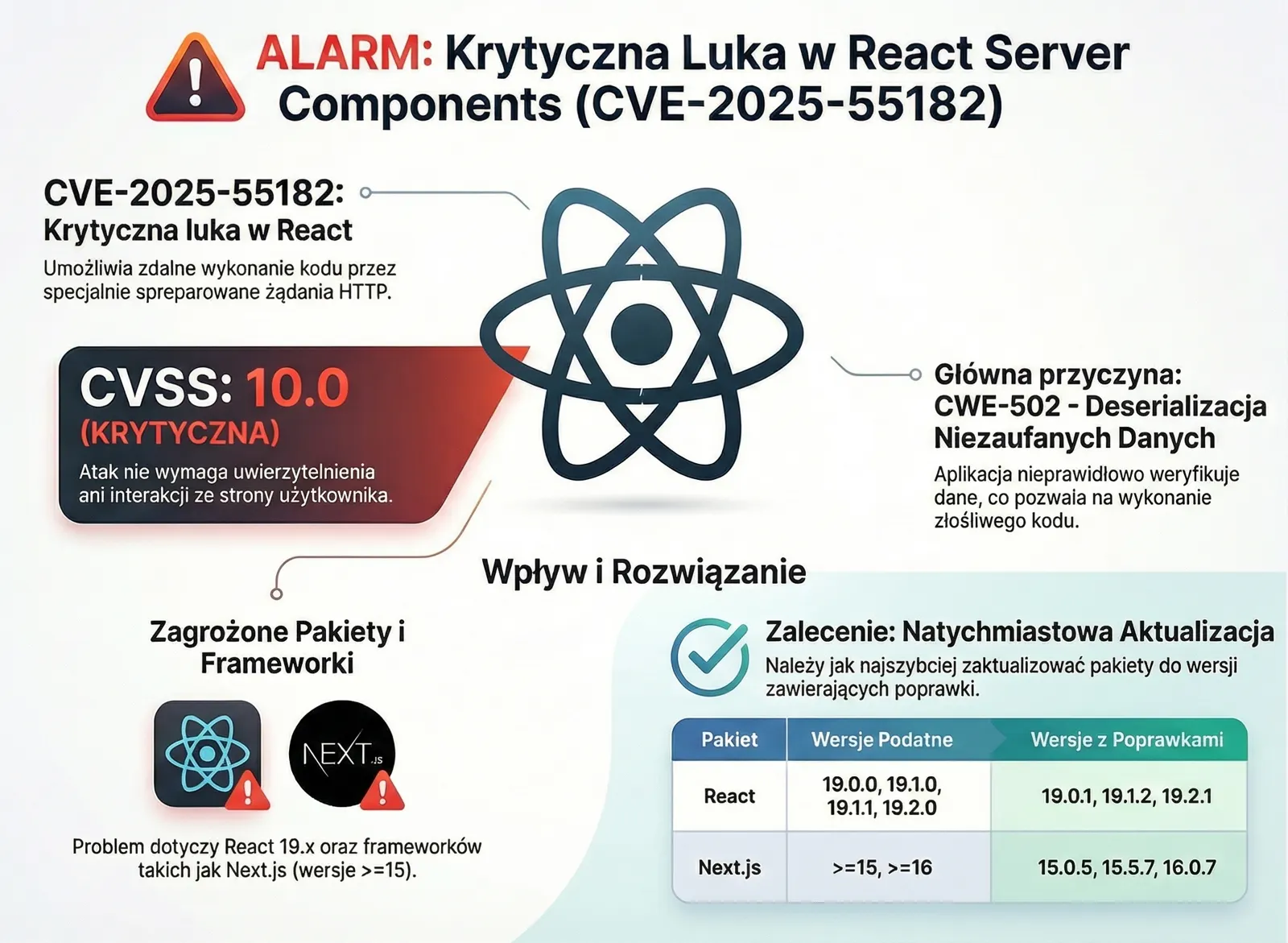
A critical flaw in React Server Components (CVE-2025-55182) enables unauthenticated remote code execution and scored a maximum CVSS 10.0. Patch now.
Cl0p exploited an Oracle E-Business Suite zero-day (CVE-2025-61882) to steal corporate data. Oracle's fix is out: patch now and check for compromise.
A free consultation with one of our experts — no obligation, in full confidence.
Let's talkWe'd like to use Google Analytics cookies to see how many people visit the site and which content is useful. We'll only set them if you agree. You can change your decision at any time via the “Cookie settings” link in the footer. Cookies Policy