AI-Powered Cyberattacks in 2025: Key Takeaways from the ENISA and OpenAI Reports
How AI is fueling phishing, malware and disinformation in 2025, and helping defenders fight back. Key takeaways from the latest ENISA and OpenAI reports.
Analysis
Is AI eroding our ability to think, write and read deeply? Derek Thompson's warning about the quiet decline of human thinking in the age of ChatGPT.

We live in an age that is captivated by the idea of superintelligent machines and terrified of it at the same time. Headlines warn of artificial intelligence that will take our jobs, outperform us in every field and perhaps push us to the margins of history. In his provocative essay "The End of Thinking," Derek Thompson makes a different argument. He turns our attention away from gleaming server farms and toward our own minds. In his view, the real threat is not the dramatic rise of "thinking machines." It is the quiet, steady decline of "thinking people." We are so focused on how technology might surpass us in the future that we fail to notice how, step by step, it is already taking away our most basic abilities. This is not a story about machines rising up against us. It is a story about our voluntary surrender.
Thompson does not build his case on futuristic speculation. He relies on hard data and observation, and together they point to a systemic problem. This is not a single crack. It is the slow erosion of the foundations of our civilization: reading, writing and, above all, thinking.
The first casualty of the digital age is the ability to stay focused on a long, complex text. The US "Nation's Report Card" (NAEP) is sounding the alarm: reading scores have fallen to their lowest level in 32 years. The problem runs deeper than the statistics. Even the most gifted teenagers, the country's future elite, have essentially stopped reading anything longer than a paragraph. Daniel Shore, chair of the English department at Georgetown University, notes with regret that his students struggle to focus on even a single sonnet. Young people are arriving at elite universities without ever having read a whole book. By optimizing for tests, the education system may have unwittingly helped break literature into fragments, teaching students to comprehend short excerpts while training them out of engaging with a work as a whole.
Writing has always been inseparable from thinking. We do not first think and then simply transfer finished thoughts to the page. The act of writing is itself an act of thinking: sharpening ideas, structuring arguments and discovering new connections. Today, this essential process is being outsourced on a massive scale. AI tools such as ChatGPT have become for students what the calculator became for math, but with far more dangerous consequences. One student put it bluntly: "College is just how well I can use ChatGPT at this point." Professors are watching this trend with alarm, warning that universities will soon graduate people who are "essentially illiterate": graduates with diplomas but without the ability to formulate their own thoughts. As the editors of Nature argue, handing the entire writing process over to AI deprives researchers of a crucial stage of their work: understanding what they have actually discovered and why it matters.
Losing these fundamental skills is not just an academic concern. It threatens the functioning of society as a whole.
Thompson illustrates this with the example of medical students. Although they are encouraged to use AI as a powerful diagnostic tool, the students themselves are growing uneasy. "I worry these tools will erode my ability to make an independent diagnosis," one of them says. After a day in which he analyzed every case study with the help of AI, he had a sobering realization: he "hadn't thought independently about a single patient." It is a glimpse of a future in which the expert becomes little more than a skilled interface operator, someone who is "slightly better than the patient at prompting AI."
The author borrows the concept of "time under tension" from strength training. Muscles grow not simply from lifting a weight but from holding it under tension long enough. The mind works the same way. Deep thinking, which takes effort and time, is what builds our intellectual "muscles." When we give up that effort in favor of quick, instant answers from AI, we condemn our minds to atrophy. Faced with the possible arrival of superintelligence, instead of strengthening our abilities, "we are preparing by lobotomizing ourselves."
Despite this grim diagnosis, Thompson does not leave us without hope. He points out that culture often works as a feedback loop: every action triggers a reaction. We may be on the verge of a quiet revolution, a backlash against lazy intellectual consumerism. The question he hears most often from worried parents is: "What should my child study in the age of AI?" His answer is unequivocal: the specific major does not matter. What matters is one universal skill, the very one whose decline we are watching with such concern: the ability to think deeply and independently.
Paradoxically, it is precisely in the face of powerful machines that our human capacity for reflection, creativity and critical analysis becomes more valuable than ever. The real challenge of our time, then, is not artificial intelligence. It is us, and our shrinking willingness to make an intellectual effort. It is up to us whether we let our minds fade in the glow of our screens or fight for what makes us human.
Source: Based on Derek Thompson's article "The End of Thinking."
Aleksander
Read also: AI: The New Weapon in the Cybercriminal Arsenal and Why Is Poland the Second Most Attacked Country?.
Read more
How AI is fueling phishing, malware and disinformation in 2025, and helping defenders fight back. Key takeaways from the latest ENISA and OpenAI reports.
SOC analysts are drowning in false alarms. Here's how SOAR playbooks and agentic AI cut response times from hours to seconds and help end alert fatigue.
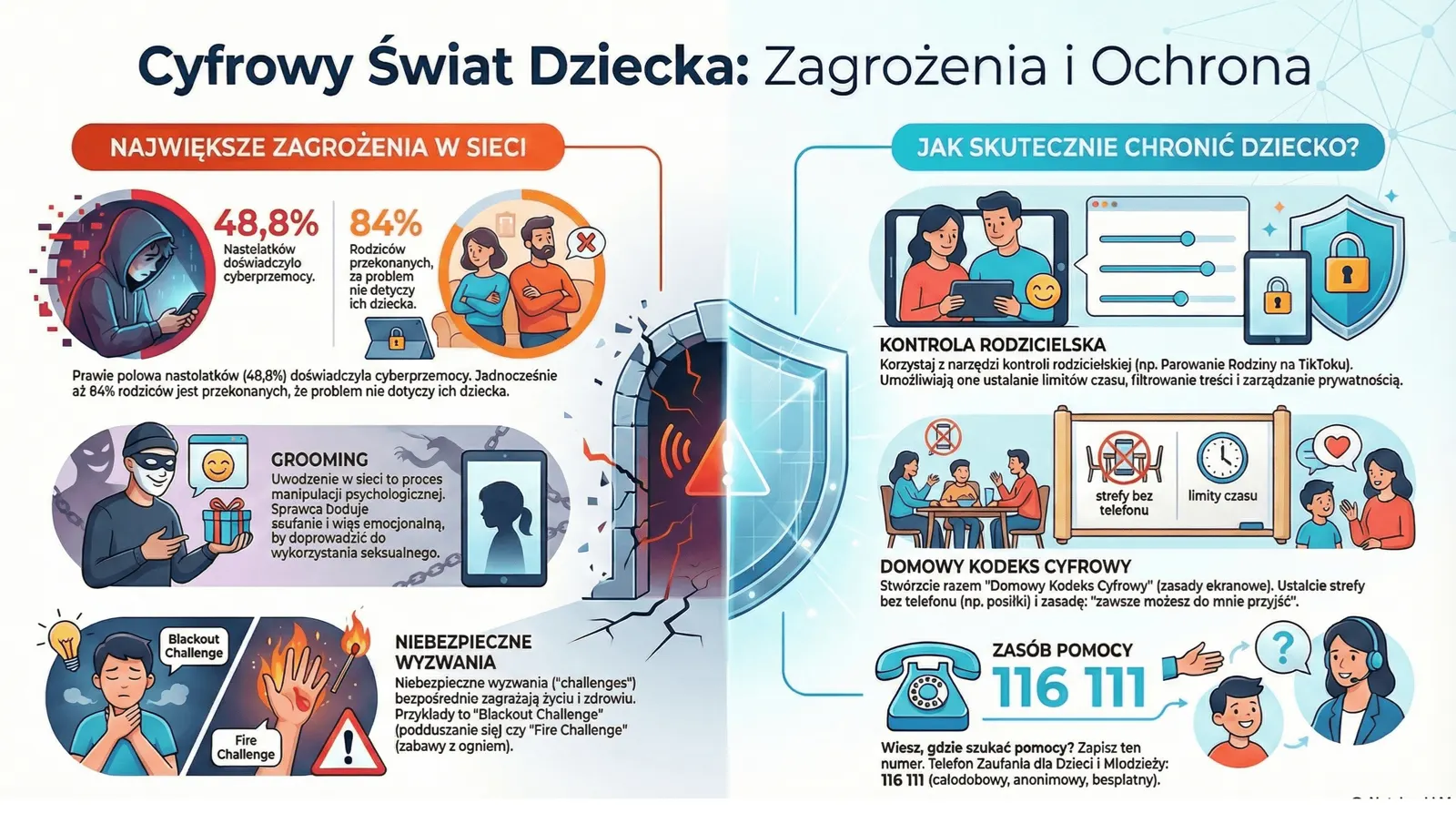
Over 600,000 incident reports. We break down NASK and police data on deadly TikTok challenges, Roblox scams, and Poland's sexting legal trap.
A free consultation with one of our experts — no obligation, in full confidence.
Let's talkWe'd like to use Google Analytics cookies to see how many people visit the site and which content is useful. We'll only set them if you agree. You can change your decision at any time via the “Cookie settings” link in the footer. Cookies Policy