Anatomy of a Disaster: Why Cloudflare Went Dark — A Technical Breakdown of the November 18 Outage
On November 18, 2025, Cloudflare went dark for hours. It wasn't a DDoS attack but a database permissions change. Here's the full technical breakdown.
Analysis
On November 18, 2025, a Cloudflare outage took down X, ChatGPT and Zoom just a month after AWS. Here's what happened and why it matters.

If it feels like the digital world has been running on a wing and a prayer lately, you're right. Today, November 18, 2025, the internet held its breath once again, and millions of users got an unplanned coffee break (or a calming cup of chamomile).
Just 30 days after Amazon Web Services (AWS) knocked out half the web with a DNS failure, Cloudflare has joined the infamous "Total Shutdown" club. What we're seeing today is more than another technical glitch. It's a harsh reminder of how centralized and fragile our digital world has become.
Before we dig into today's chaos, let's go back a month. On the morning of Monday, October 20, AWS's US-EAST-1 region went down. That time the culprits were the DNS system and the DynamoDB database. The result? Banks, Fortnite, Slack, and even smart vacuum cleaners stopped working.
Back then, it looked like a one-off accident. Today's events suggest that fall 2025 has been an unusually unlucky season for the infrastructure giants.
Today's drama began at exactly 11:20 UTC. That's when the systems at Cloudflare went haywire. Cloudflare is the company that keeps much of the internet in line every day, providing security and fast load times for millions of websites.
Monitoring tools picked up what was described as a "spike in unusual traffic." This was not an ordinary surge in popularity. It was a digital tsunami that hit the servers so hard they could no longer process requests. The result? The dreaded HTTP 500 (Internal Server Error) showed up across the web.
The company has not yet confirmed a cause. Speculation centers on two scenarios:
Cloudflare acts as an intermediary (CDN) for a huge share of the web, so a failure at one of its main nodes set off an immediate domino effect. Within a few hours, Downdetector had logged more than 11,000 reports of problems.
The list of affected services reads like a who's who of today's internet:
One of the most interesting, and most unsettling, parts of today's recovery was how it was done. The outage also hit Cloudflare's VPN service, Cloudflare WARP. To take load off the infrastructure and roll out fixes, engineers had to make drastic decisions.
In some regions, including London, access to WARP was temporarily and deliberately shut off. Think of it as cutting power to one neighborhood so the transformer for the whole city doesn't burn out. These "system modifications" gradually brought error rates down and restored traffic, though they left a bad taste.
The November 18, 2025 Cloudflare outage, coming a month after the AWS incident, raises hard questions. We've built an internet that is fast and secure, but it rests on just a few pillars. When one of them cracks, whether from an attack or human error, the whole roof comes down.
Experts agree that today's chaos is a textbook example of a Single Point of Failure. Companies need to get serious about redundancy and diversifying their providers, because relying on a single mega-provider is turning into a game of Russian roulette.
Cloudflare has promised a detailed post-mortem. We're eager to read it and learn what exactly was behind the "spike in unusual traffic." Was it an attempted cyberattack on a global scale? Time will tell.
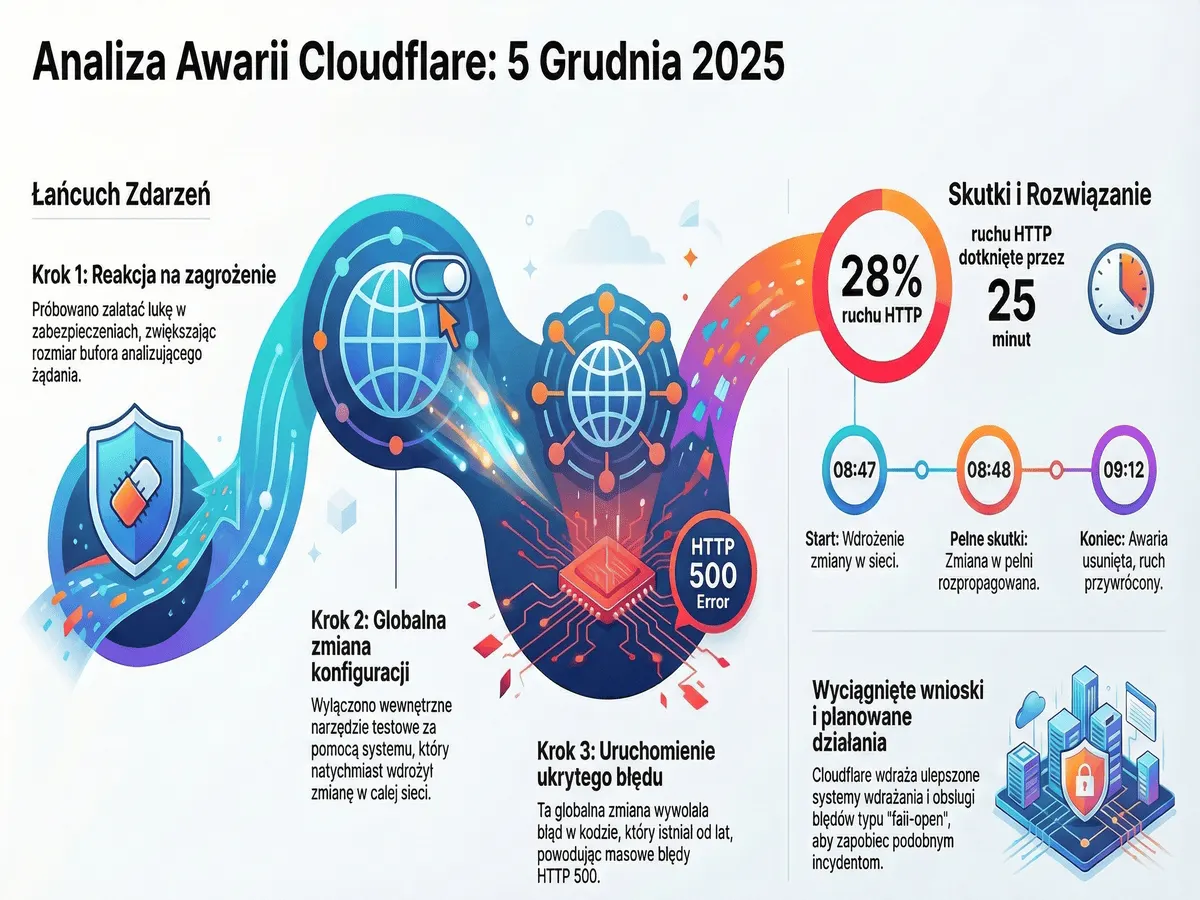
Further incidents: Unfortunately, the November outage was not the last. Cloudflare went down again on December 5, causing another wave of access problems for key services.
For now, let's be glad this article loaded at all.
Sources:
Aleksander
Read more
On November 18, 2025, Cloudflare went dark for hours. It wasn't a DDoS attack but a database permissions change. Here's the full technical breakdown.
Cloudflare's 25-minute outage on December 5, 2025, explained: a React CVE fix, a WAF buffer change and a fatal Lua nil-value bug.
A DNS failure in AWS US-EAST-1 on October 20, 2025 took down Slack, Zoom, Fortnite, Coinbase and banks worldwide. Here's what broke and why.
A free consultation with one of our experts — no obligation, in full confidence.
Let's talkWe'd like to use Google Analytics cookies to see how many people visit the site and which content is useful. We'll only set them if you agree. You can change your decision at any time via the “Cookie settings” link in the footer. Cookies Policy