Denmark CPR Data Breach: 8.8 Million People Exposed Through a Private Company's Account
Attackers spent 10 days pulling names, addresses and CPR numbers via a partner firm's legitimate access. What it teaches about third-party access risk.
Incidents
The Dom Development cyberattack exposed PESEL numbers, salaries and children's data. What leaked, what it means, and how to protect yourself now.

Buying a home is one of the biggest moments in anyone's life. It brings excitement, plans for the future and a sense of security. Few people at that point are thinking about servers, databases or cybersecurity. Yet, as the incident at Dom Development, one of Poland's largest residential developers, has shown, those two worlds are closely linked. The cyberattack, which the company said it detected on December 4, 2025, is more than a corporate problem. It is a personal threat to thousands of customers, employees and business partners who never expected their digital identity to be at stake when they bought an apartment. The breach exposes an uncomfortable truth: our private lives are tied much more closely than we think to the companies we trust. In this analysis, we look at the most alarming parts of the incident and explain how to protect yourself from its fallout.
Dom Development S.A. is a leading Polish residential developer. It has been in the construction market since 1996 and is headquartered in Warsaw. It is one of the largest companies in its sector in Poland and builds and sells apartments in both the mainstream and premium segments. Dom Development operates in Poland's key cities. It runs projects in Warsaw and, through its subsidiaries, in the Tricity area (via Euro Styl S.A.), Wrocław (e.g. Dom Development Wrocław Sp. z o.o.) and Kraków (e.g. Dom Development Kraków Sp. z o.o.). Dom Development S.A. has been listed on the Warsaw Stock Exchange (GPW) since 2006.
When we hear about a data breach, we instinctively think about our own exposure: my bank account, my PESEL number (Poland's national identification number), my email address. The Dom Development incident breaks that pattern. Its most disturbing feature is that the data at risk goes beyond people directly connected to the company. It also covers their family members, including minors. That is a new and far more personal level of threat.
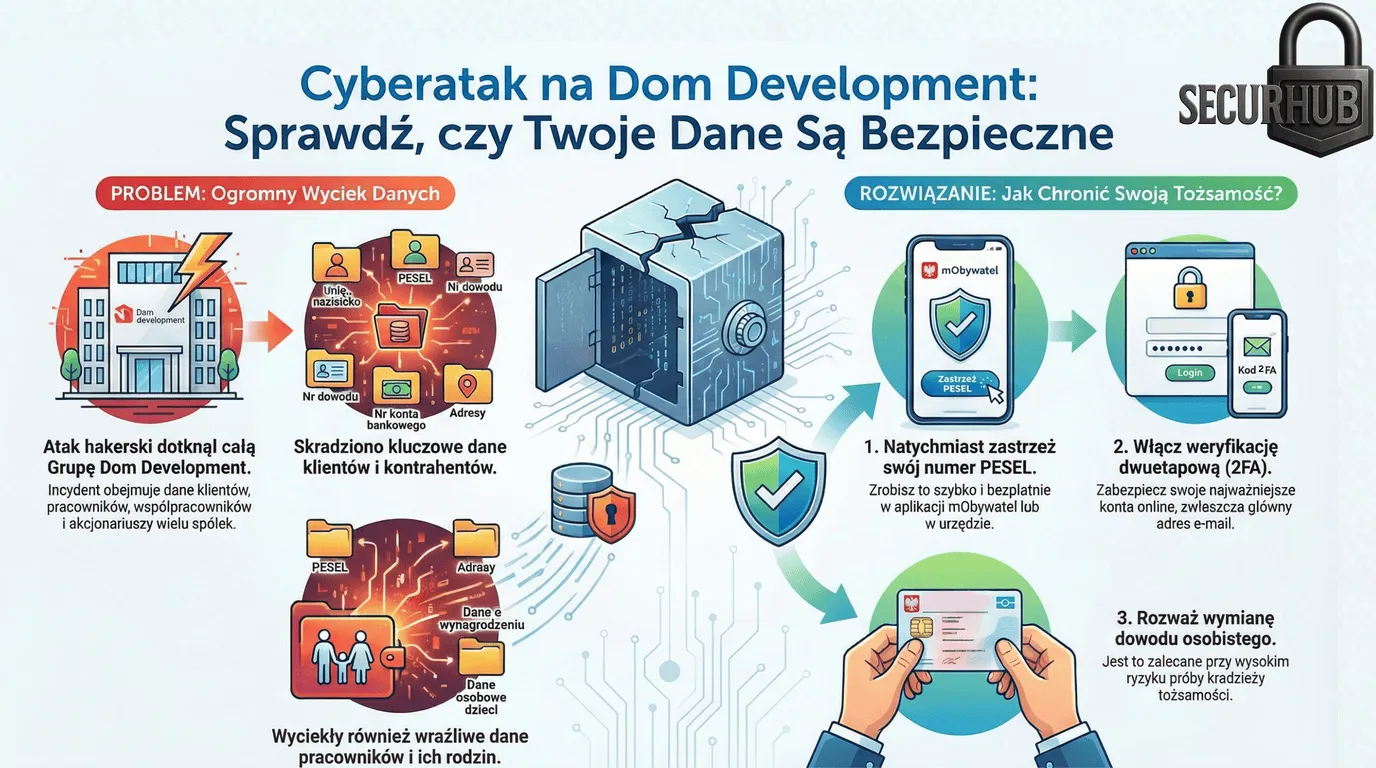
According to the company, the attackers may have stolen highly sensitive data on the families of employees and contractors. The scope of that information is staggering:
What does this mean in practice? Child identity theft is especially insidious and dangerous. A child's PESEL number is "clean": it has no credit history and no debts. For fraudsters, it is the perfect tool for taking out long-term loans or setting up shell companies. Worse still, this kind of fraud can go unnoticed for years, and the consequences can be devastating. Imagine a young person who, on reaching adulthood, discovers they cannot get a student loan, open their first credit card or even pass an employment background check because their identity was ruined long ago. The scope of the adult data that fell into the wrong hands was just as alarming.
A list of the stolen data alone does not capture how serious this is. Taken together, the pieces form what could be called a complete "digital identity theft kit." In criminals' hands, it can do far more than secure a quick payday loan. Let's look at exactly what may have been stolen, because it goes well beyond the usual information.
For people who bought an apartment, negotiated a contract or worked with the developer, this data is enough to build a full financial, property and even personal profile.
Staff data is just as sensitive. It reveals not only a person's entire career path but also the most private areas of their life.
With a dataset this complete, a single person could take over almost the victim's entire digital life: taking on debt in their name, impersonating them with government agencies and hijacking their online accounts.
Complex corporate structures mean we often don't realize how interconnected different companies are. The Dom Development attack is a clear illustration of how an incident at one company can cascade through an entire ecosystem of related businesses. That is an important lesson for consumers and investors alike.
According to the official notice, the cyberattack affected the entire Dom Development Group. This means data processed by many different entities is at risk, including:
Why does this matter? A customer who dealt only with Dom Development Kredyty may have assumed their data was processed there and nowhere else. In reality, their information sat within a broader IT infrastructure that became the target of the attack. This kind of domino effect is often the result of shared IT infrastructure, centralized databases or group-wide data processing agreements. A single weak point can compromise the security of the whole group.
The situation is serious, but people affected by the breach are not defenseless. The key is to act immediately and deliberately to reduce the risk. Below is an action plan based on the company's own recommendations and cybersecurity best practices.
These steps are no longer extraordinary precautions. They are the foundation of basic digital hygiene today.
The Dom Development breach is a powerful reminder of a few painful truths. First, our data reaches much further than we think. It covers our finances, our property and, most worryingly, our entire families. Second, even the biggest market players, the ones we trust with such sensitive information when we buy a home, can fall victim to an attack.
This incident is a bitter lesson about the price we pay for digital convenience. The question remains: are we, as a society, ready to treat our personal data as seriously as the keys to our own home?
Aleksander
Sources:
Dom Development has committed to notifying people whose data may have been compromised directly. If you were a customer, employee or business partner of any company in the group, you should receive an official notification. You can also contact the developer directly or check the notices in the privacy policy section of its website.
Freeze your PESEL number in the mObywatel app right away (the service is free). It is the single most important step to stop anyone from taking on financial obligations in your name. Next, turn on two-factor authentication (2FA) on all your key accounts, especially your primary email inbox, and create an account with the Credit Information Bureau (BIK) with alerts turned on.
Yes. Under the GDPR (Article 82), you have the right to compensation for material and non-material damage resulting from a personal data breach. To pursue a claim successfully, you must show that you suffered actual harm (e.g. identity theft or financial loss) and that the breach caused that harm. It is worth consulting a lawyer who specializes in data protection.
Read more
Attackers spent 10 days pulling names, addresses and CPR numbers via a partner firm's legitimate access. What it teaches about third-party access risk.
A Spanish e-learning platform was hit by a massive breach exposing data on over 6 million users, now up for sale on a hacker forum.
Data on millions of VoyageSecure customers, including travel histories and contact details, is for sale on the dark web after a cloud misconfiguration.
A free consultation with one of our experts — no obligation, in full confidence.
Let's talkWe'd like to use Google Analytics cookies to see how many people visit the site and which content is useful. We'll only set them if you agree. You can change your decision at any time via the “Cookie settings” link in the footer. Cookies Policy