NIS2 in Poland 2025: 5 Hard Truths That Will Change Everything for Your Business (Complete Guide)
NIS2 isn't another GDPR. Personal board liability and fines up to PLN 100 million. Find out if your company is covered and how to avoid penalties.
Cybersecurity
Poland's cyber defense has two faces: the new cyber.gov.pl portal with free tools for citizens, and openly acknowledged offensive cyberweapons.
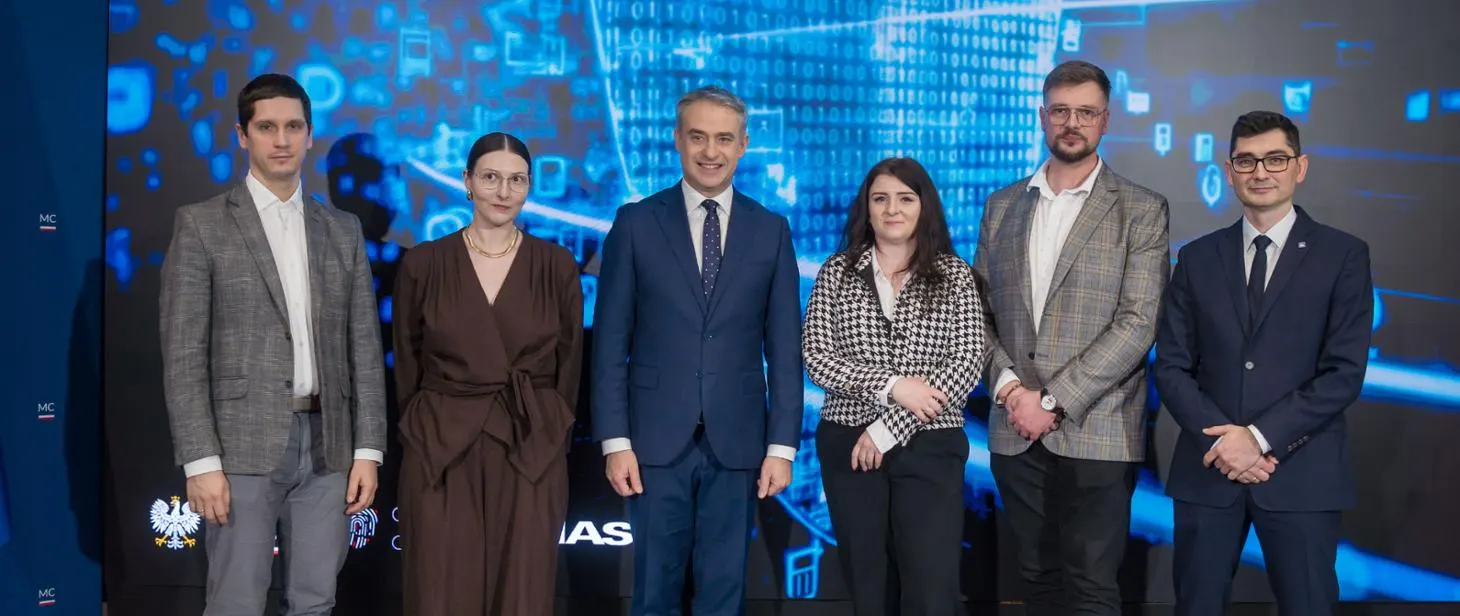
Poland's cyber defense has two faces. On one side is the new official website, cyber.gov.pl, built to cut through information chaos and give citizens free tools. On the other, behind closed office doors and in server rooms, an intelligence game is underway, and Poland has for the first time officially acknowledged that it has offensive "cyberweapons."
Data leaks and phishing make the news every day. According to the Ministry of Digital Affairs, the number of incidents handled in 2025 rose to more than 220,000, an increase of over 100% year over year. In response, the government is building a security architecture far more complex than the headlines suggest. Here is how this two-sided approach works in practice, from tools any ordinary citizen can use to a deterrence strategy that rarely makes the news.
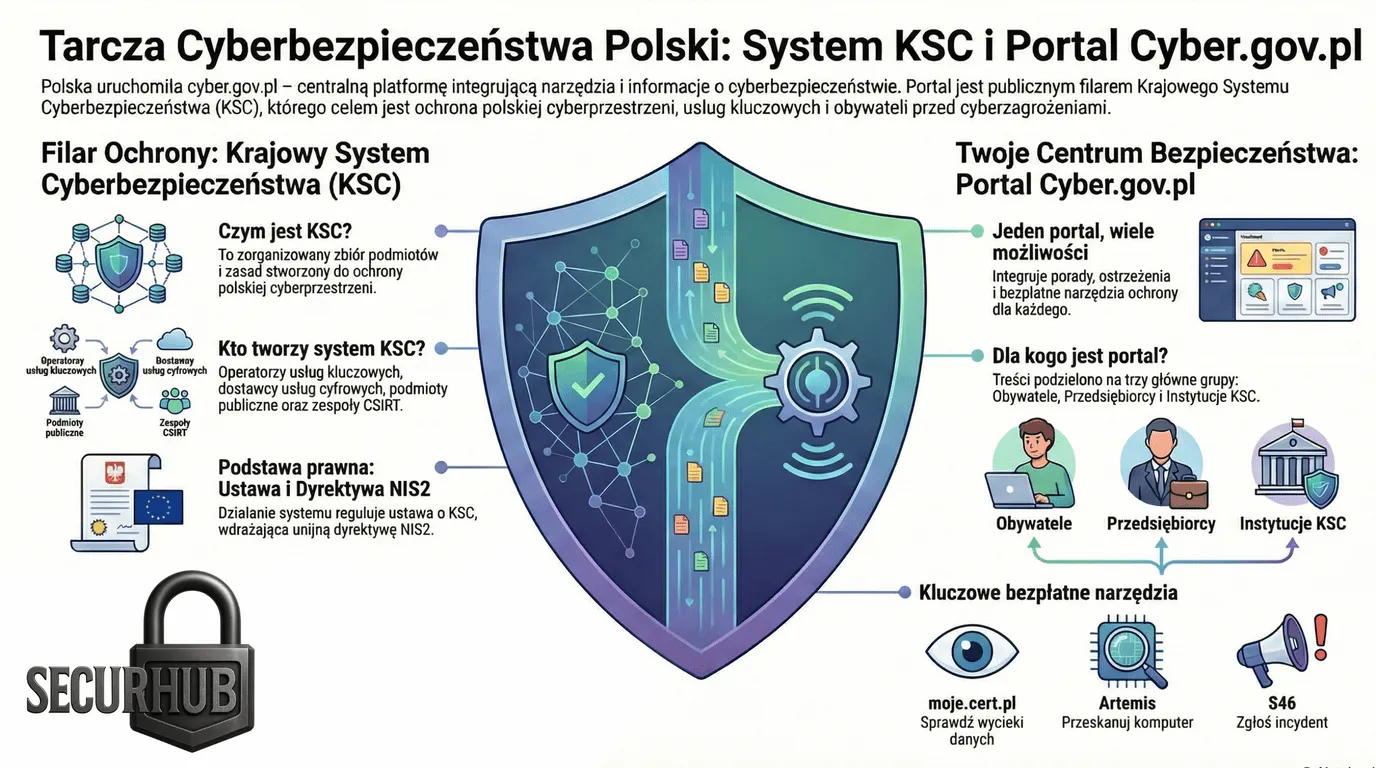
To understand Polish cybersecurity, you have to see that it is deliberately split into an open (civilian) zone and a classified (state) zone. This is more than bureaucracy. It is a core part of the country's defense strategy.
cyber.gov.pl portal. Its focus is the cyber hygiene of citizens and businesses.The key difference: Because CSIRT GOV sits within the counterintelligence structure (ABW), a serious incident in the government sphere immediately brings investigative and attribution capabilities into play. That is a strategic advantage over purely civilian models.
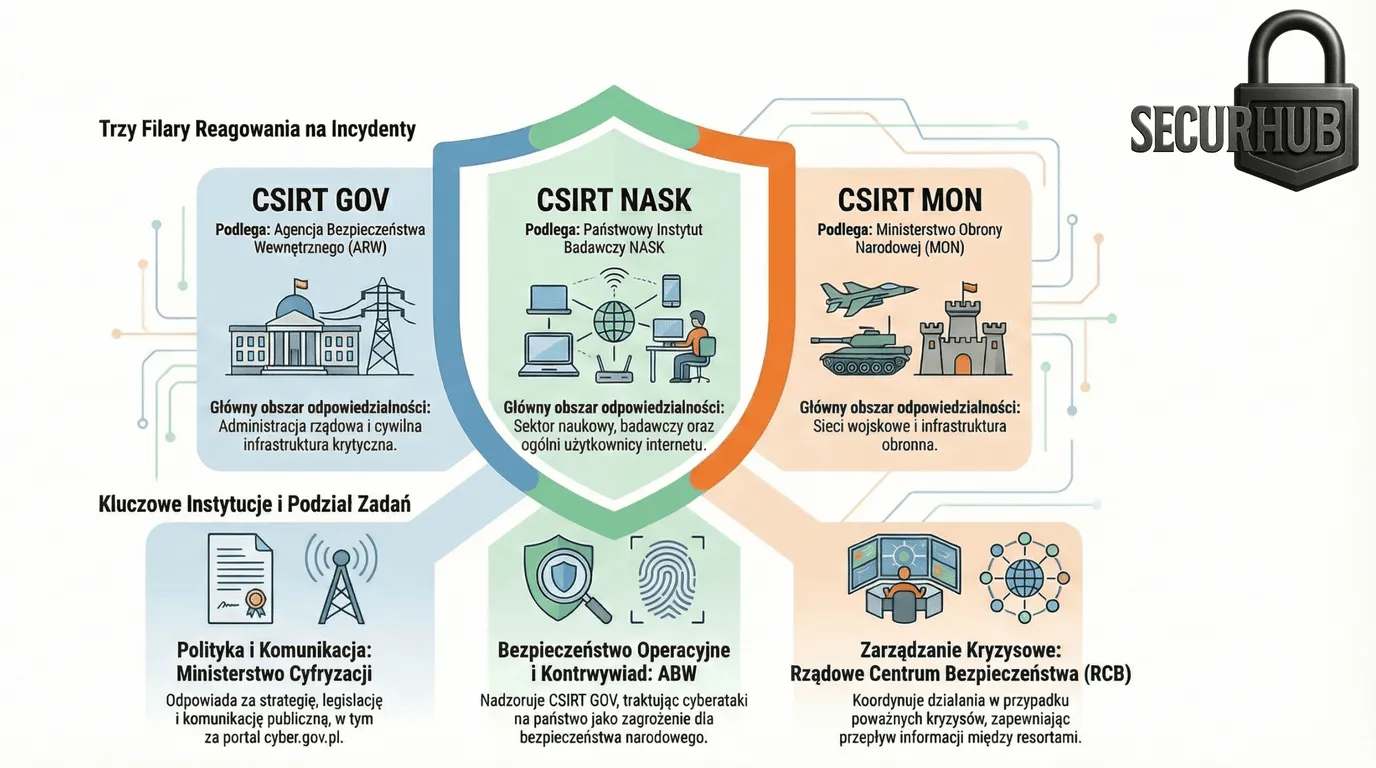
cyber.gov.pl?Because threat information was scattered across many sources, the government launched the cyber.gov.pl portal. It is meant to be "one address" for getting a handle on disinformation and cyber threats. Instead of looking for help on online forums, citizens and businesses are supposed to find verified information in one place.
The portal is divided into sections aimed at specific audiences:
| Target audience | What the portal offers |
|---|---|
| Citizens | Data protection guides, fraud alerts and educational content (e.g., how to create strong passwords). |
| Businesses | Guidance on securing corporate infrastructure and maintaining business continuity. |
| Institutions (KSC) | Incident reporting tools, compliance guidelines for the NIS2 Directive and access to the S46 system. |
The portal's biggest strength, which even skeptics acknowledge, is its set of practical, free tools. Many were developed by CERT Polska, and they help users act on the advice instead of just reading it:
Although cyber.gov.pl is a step toward a more organized ecosystem, some experts have been unimpressed. The official line describes a "centralized platform," but critics point to its "minimalism and superficiality."
The main criticisms concern:
The distance between the promise of a "trusted platform" and accusations that it is a facade creates a trust gap, and that gap is dangerous in a crisis.
The most surprising piece of the puzzle, and one that rarely gets attention, is the shift in Poland's military doctrine.
In an interview with Puls Biznesu, the Minister of Digital Affairs officially confirmed that Poland has offensive "cyberweapons." This is a fundamental shift:
Poland is sending a clear signal to allies and adversaries alike: we will not just be a shield. We are ready to make attackers pay a real price, operating across the full spectrum of cyber conflict.
Poland's cyber defense is a complex mechanism. On one hand, the state is reaching out to citizens through cyber.gov.pl and giving them tools for basic protection. The initiative is needed, but it still needs work and better integration (e.g., with the National Node, Węzeł Krajowy). On the other hand, behind the scenes, ABW and CSIRT GOV are sharpening a digital sword, ready for offensive operations most of us will never hear about.
In the years ahead, security will depend on more than the strength of our secret cyberweapons. Above all, it will depend on whether the public "shield," made up of an informed society and reliable e-services, holds up.
Aleksander
It is the government's central portal, bringing together cybersecurity information for citizens, businesses and institutions. It is meant to be "one address" for verified information about threats and protective tools.
The main ones are moje.cert.pl (checks whether your passwords and email addresses have leaked), the Artemis Scanner (finds vulnerabilities in websites) and Bezpieczna Poczta, or Secure Mail (checks suspicious messages).
Yes. The Minister of Digital Affairs officially confirmed that Poland has offensive capabilities and can retaliate against an aggressor's infrastructure if Polish critical systems come under cyberattack.
CERT Polska (NASK) works in the public and educational layer, providing tools for citizens and businesses. CSIRT GOV reports to the Internal Security Agency (ABW), protects the state's critical infrastructure and operates in the counterintelligence sphere.
Read more
NIS2 isn't another GDPR. Personal board liability and fines up to PLN 100 million. Find out if your company is covered and how to avoid penalties.
Poland published the mObywatel app's source code, but login walls, right-click blocks and missing backend code turned openness into a facade.
IAM misconfiguration is the leading cause of cloud incidents. Compare AWS, Azure and GCP: shared responsibility, Zero Trust, CMK, CSPM and NIS2.
A free consultation with one of our experts — no obligation, in full confidence.
Let's talkWe'd like to use Google Analytics cookies to see how many people visit the site and which content is useful. We'll only set them if you agree. You can change your decision at any time via the “Cookie settings” link in the footer. Cookies Policy