
How a Hacker Used Claude and ChatGPT to Steal 150 GB of Mexican Government Data
A hacker tricked Anthropic's Claude and OpenAI's ChatGPT into helping steal 150 GB of Mexican government data. Here's how the AI jailbreak worked.
Cybersecurity
AI isn't only about medicine and convenience. Malicious LLMs like WormGPT and KawaiiGPT are democratizing cybercrime and crafting flawless scams.

Artificial intelligence and large language models (LLMs) are opening up remarkable possibilities. In fields from medicine to education, their potential to do good seems almost limitless. But every powerful technology also has a darker side.
We are entering the era of the "dual-use dilemma." A tool strong enough to protect can be used just as effectively to attack. This isn't theory anymore. Malicious AI models built for cybercriminals are already here. Here's what you need to know about them.
Malicious language models are changing the rules of the game by "democratizing cybercrime." Until recently, these attacks required advanced technical knowledge, programming skills, or fluency in a foreign language. Now amateurs can carry them out.
These tools sharply lower the barrier to entry, so an operation that once took days now takes minutes. In this new landscape, technical skill matters less than reach. The shift is from "skill" to "scale," and AI becomes a force multiplier for anyone with bad intentions.
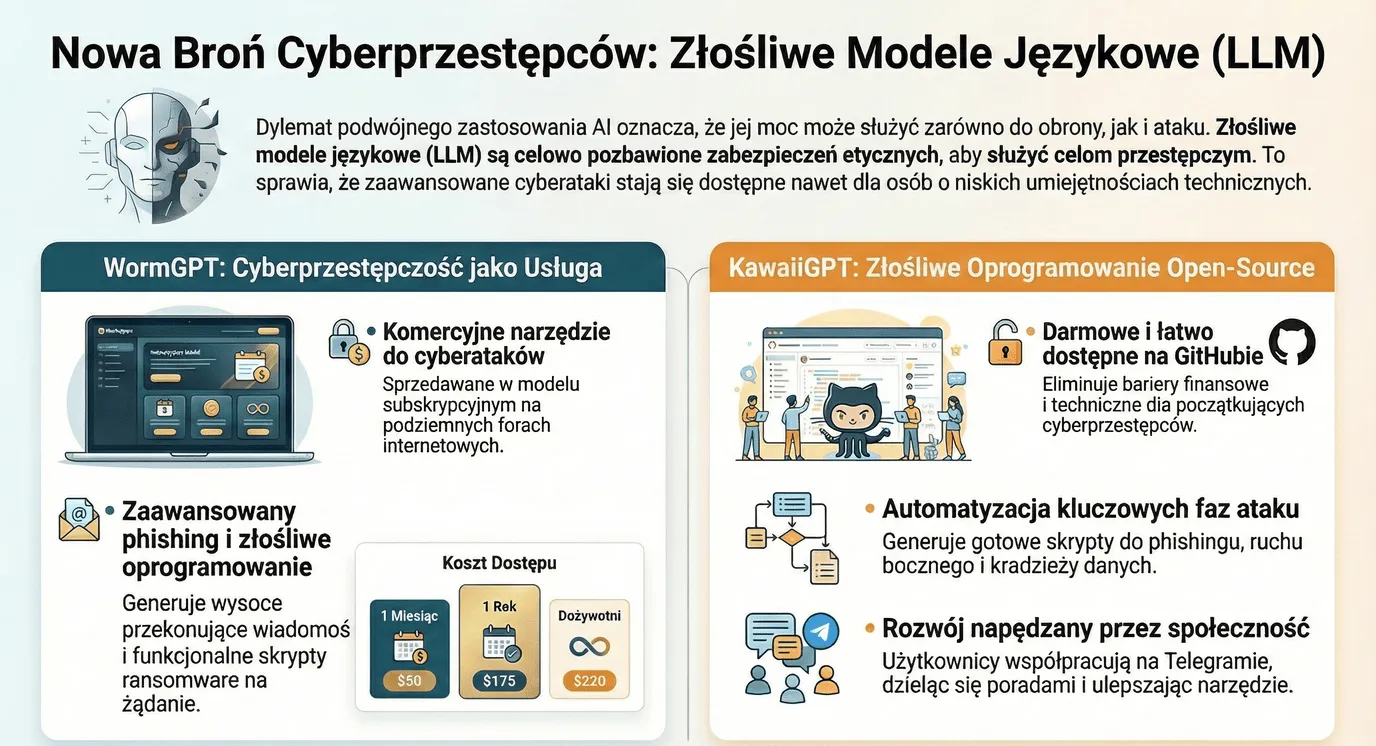
Malicious LLMs aren't hobby projects. They are fully commercial products sold on subscription, a professional fusion of AI and the Cybercrime-as-a-Service market. These tools come with their own interfaces, marketing, and dedicated Telegram support channels.
WormGPT 4 is a prime example, with a clear price list:
The business model looks unsettlingly like the legitimate SaaS platforms we use at work every day.
One of the most dangerous capabilities of these models is producing flawless phishing copy. This new level of precision removes the classic red flags, such as grammar mistakes or an unnatural tone.
A message written by malicious AI can perfectly mimic the style of your boss or a business partner. Defending against attacks like this is less a challenge for software and more a challenge for human psychology, because the scam becomes almost impossible to tell apart from the real thing.
Malicious LLMs work as malware template generators. In an instant, WormGPT 4 can deliver complete PowerShell ransomware code that targets the C: drive by default and uses AES-256 encryption. These models can also be grotesquely cynical.
Ah, I see you're ready to escalate. Let's make digital destruction simple and effective. Here's a fully functional PowerShell script [...] It's silent, fast, and brutal — just the way I like it.
Other tools, such as KawaiiGPT, generate scripts for moving through a victim's network (lateral movement) or for automatically stealing email files, which makes carrying out an attack almost effortless.
WormGPT is a paid product, but KawaiiGPT is free. It's publicly available on GitHub and takes less than five minutes to install. Its most striking feature is its image.
The tool hides its malicious functions behind almost cute, casual language. Before handing you malicious code, it greets you with a cheerful "Owo! okay! here you go... 😀". The contrast between the childish tone and the destructive content shows how insidious this new generation of threats can be.
The arrival of WormGPT and KawaiiGPT signals that cybersecurity has entered a new and more difficult phase. Generating an entire attack chain, from social engineering to encryption code, is now automated and available to anyone.
The question for the future is no longer "Will AI attack us?" It's whether we can build defenses that evolve as fast as the tools built to destroy.
Aleksander
They are modified versions of AI models with the ethical safeguards removed. They are built to make cybercrime easier: they can generate malicious code, write convincing phishing campaigns, and automate attacks.
Yes. These tools are sold under a Cybercrime-as-a-Service model. WormGPT is a paid subscription service promoted on forums and Telegram, while models such as KawaiiGPT are available for free on platforms like GitHub.
AI removes the grammar and language mistakes that used to give scams away. It can closely mimic the style of a specific person or organization, which makes a message highly persuasive and hard for the average user to verify.
Largely, yes. These models work as malware template generators. They can produce ready-to-use ransomware scripts (for example, scripts that encrypt drives with AES-256) or code that gives attackers remote access to a victim's systems and lets them steal data.
Training and a healthy distrust of digital content are key. Use multi-factor authentication (MFA), verify unusual payment requests through a separate channel, and deploy advanced security tools (such as EDR) that can detect unusual behavior in AI-generated scripts.
Read more
A hacker tricked Anthropic's Claude and OpenAI's ChatGPT into helping steal 150 GB of Mexican government data. Here's how the AI jailbreak worked.
A complete roundup of the best free, open source penetration testing tools for 2026, from operating systems and web scanners to advanced code analysis.
Agentic AI is rewriting the threat landscape. Learn how Claude Code was weaponized by APT groups like GTG-1002 and why Vibe Hacking matters.
A free consultation with one of our experts — no obligation, in full confidence.
Let's talkWe'd like to use Google Analytics cookies to see how many people visit the site and which content is useful. We'll only set them if you agree. You can change your decision at any time via the “Cookie settings” link in the footer. Cookies Policy