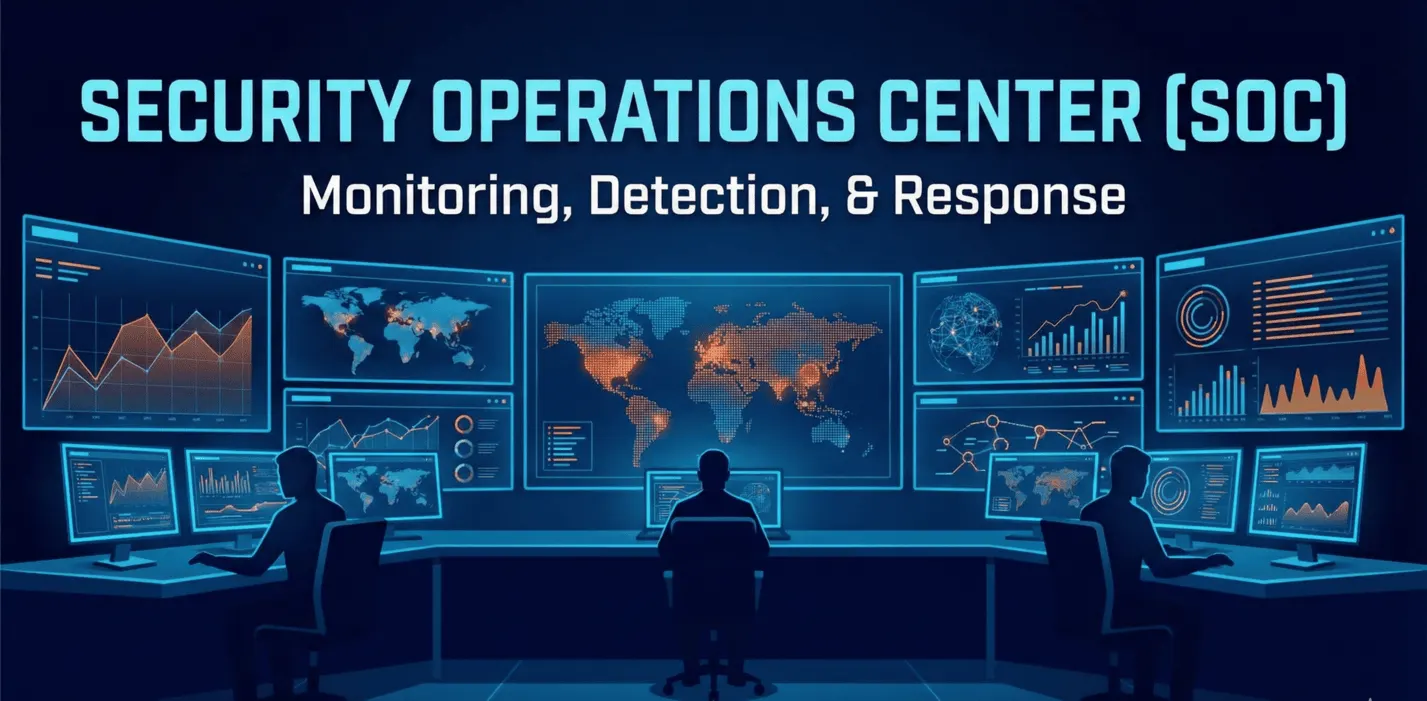
Security Operations Center (SOC): The Complete 2026 Guide to Building and Implementing a SOC
Your 2026 guide to the Security Operations Center: team structure, SIEM/XDR/SOAR, NIS2 requirements, deployment models and AI. For CISOs and IT leaders.
Cybersecurity
In-house SOC vs. SOCaaS: costs, TCO and ROI compared, a case study, and NIS2's impact on IT budgets. Why the hybrid model wins in 2026.

Deciding whether to set up a Security Operations Center (SOC) is no longer just something the IT team would like to have. The NIS2 Directive is now in force, ransomware groups keep getting more aggressive and insurers keep raising their requirements. Boards in Poland now face a clear choice: build an in-house team from scratch, or rely on an outside partner (SOC as a Service)?
Let's be honest: this is first and foremost a financial decision. It can cost your company millions of złoty a year. Or it can save you most of your security budget while giving you better protection.
In this article, we break down the Total Cost of Ownership (TCO) of both models. We'll lay out what each one really costs and point out the expenses vendors often "forget" to mention over coffee.
Many IT managers who open Excel to plan a capital budget (CAPEX) enter the price of a SIEM license and the salaries of "three IT people." Unfortunately, day-to-day operating costs (OPEX) quickly prove those assumptions wrong. This becomes especially clear once you understand what 24/7/365 monitoring actually involves. Under NIS2, it is already the standard for essential entities.
This is where estimates most often go wrong. It seems like three people should be enough to cover three shifts. They're not. To keep monitoring going around the clock for a single role (for example, first-line support), you need at least 5–6 full-time employees.
Why so many? Because a week has 168 hours. On top of that come vacation (26 days), sick leave, training (essential in this field, not a perk) and ordinary life.
Realistic market staffing costs (Warsaw, 2026 estimates):
Annual total (salaries alone): well over PLN 2 million.
Turnover also adds up. The average SOC analyst stays with one employer for only 18–24 months. Burnout from so-called alert fatigue is a real problem in this industry. When a specialist leaves, replacing them often costs the equivalent of six months' salary, counting the time spent on recruiting, onboarding and getting the team back to full productivity.
People need tools to work with. Open source is free, but only in theory. In practice, it takes a great deal of engineering work to maintain, integrate and parse logs. Commercial enterprise-grade solutions, on the other hand, come with hefty license bills.
Technology changes every day, and a team that stops training falls behind. Certifications such as SANS, OSCP and CISSP cost at least PLN 50,000 a year per team. On top of that, senior staff spend hundreds of hours building and updating playbooks, so that procedures actually work in practice instead of just looking good in a binder.
SOCaaS works a bit like cloud computing, but for security. The provider (an MSSP – Managed Security Service Provider) invests in top-tier technology, builds the processes and employs a large team of experts. Those large costs are then spread across hundreds of clients.
Take the same organization that would spend more than PLN 2 million on its own staff:
The annual TCO of SOCaaS comes to PLN 300,000–800,000.
That's a saving of about 60–75%. The math is simple: a provider's night-shift analyst monitors 20 companies at once, not just one. Your risk is the same, but the cost is shared among many clients.
Let's look at two scenarios for a typical Polish manufacturing company with 500 employees that falls under NIS2 as an important entity.
The board decides: "We want full control, so we'll do it ourselves."
The board decides: "We want results, not headcount."
In some situations, an in-house SOC is the best choice, or the only one:
For many digitally mature companies, the best option is a hybrid SOC, which combines the strengths of both models:
You pay a fraction of what a fully in-house SOC costs and protect your people from burnout by handing the repetitive work to the provider. The "brains" of the operation stay inside the company.
Before you sign off on an invoice worth millions of złoty, ask yourself three simple questions:
Whichever model you choose, remember: The most expensive SOC is the one that isn't working when you really need it.
Every company is different. If you're not sure which model fits you best, get in touch. We can prepare a free TCO analysis for your organization that compares the cost of building an in-house team with deploying the SecurHUB Managed SOC service.
Yes. Professional providers (MSSPs) operate under strict ISO 27001 standards and are audited more often than internal departments. Logs are usually sent over an encrypted channel, and access to them is tightly restricted. What matters most is signing the right contracts (an SLA and an NDA).
Yes. The NIS2 Directive doesn't require any particular deployment model. It requires organizations to have effective monitoring, detection and response in place. For many companies, outsourcing is actually the preferred way to reach compliance quickly, because SOCaaS providers already have processes and technology that meet the regulation's requirements.
The most underestimated cost is staff turnover (HR). When a senior specialist leaves, the cost of recruiting, onboarding and lost knowledge is huge. Other hidden costs include ongoing training, maintaining server infrastructure for the SIEM (storage, power, cooling), and time spent "fighting the tools" instead of analyzing threats.
With SOCaaS, you outsource the entire 24/7 operation. With a hybrid model, you share responsibility. The provider usually takes on the grunt work (first line, nights, weekends), while your in-house team focuses on strategy, security policies and responding to the most critical incidents during business hours.
Building an in-house SOC from scratch takes 6 to 18 months (recruitment, hardware purchases, deployment). Launching a SOCaaS service (connecting logs, configuring rules) usually takes 2 to 6 weeks. That difference is critical if you need to meet regulatory requirements quickly.
Read more
Your 2026 guide to the Security Operations Center: team structure, SIEM/XDR/SOAR, NIS2 requirements, deployment models and AI. For CISOs and IT leaders.
Your firewall is no longer enough. Learn why Zero Trust's "never trust, always verify" is becoming the legal and technical standard under NIS2 and DORA.
IAM misconfiguration is the leading cause of cloud incidents. Compare AWS, Azure and GCP: shared responsibility, Zero Trust, CMK, CSPM and NIS2.
A free consultation with one of our experts — no obligation, in full confidence.
Let's talkWe'd like to use Google Analytics cookies to see how many people visit the site and which content is useful. We'll only set them if you agree. You can change your decision at any time via the “Cookie settings” link in the footer. Cookies Policy