The End of "Console Clicking": How SOAR and Agentic AI Are Saving SOC Teams from Burnout
SOC analysts are drowning in false alarms. Here's how SOAR playbooks and agentic AI cut response times from hours to seconds and help end alert fatigue.
Cybersecurity
Your 2026 guide to the Security Operations Center: team structure, SIEM/XDR/SOAR, NIS2 requirements, deployment models and AI. For CISOs and IT leaders.
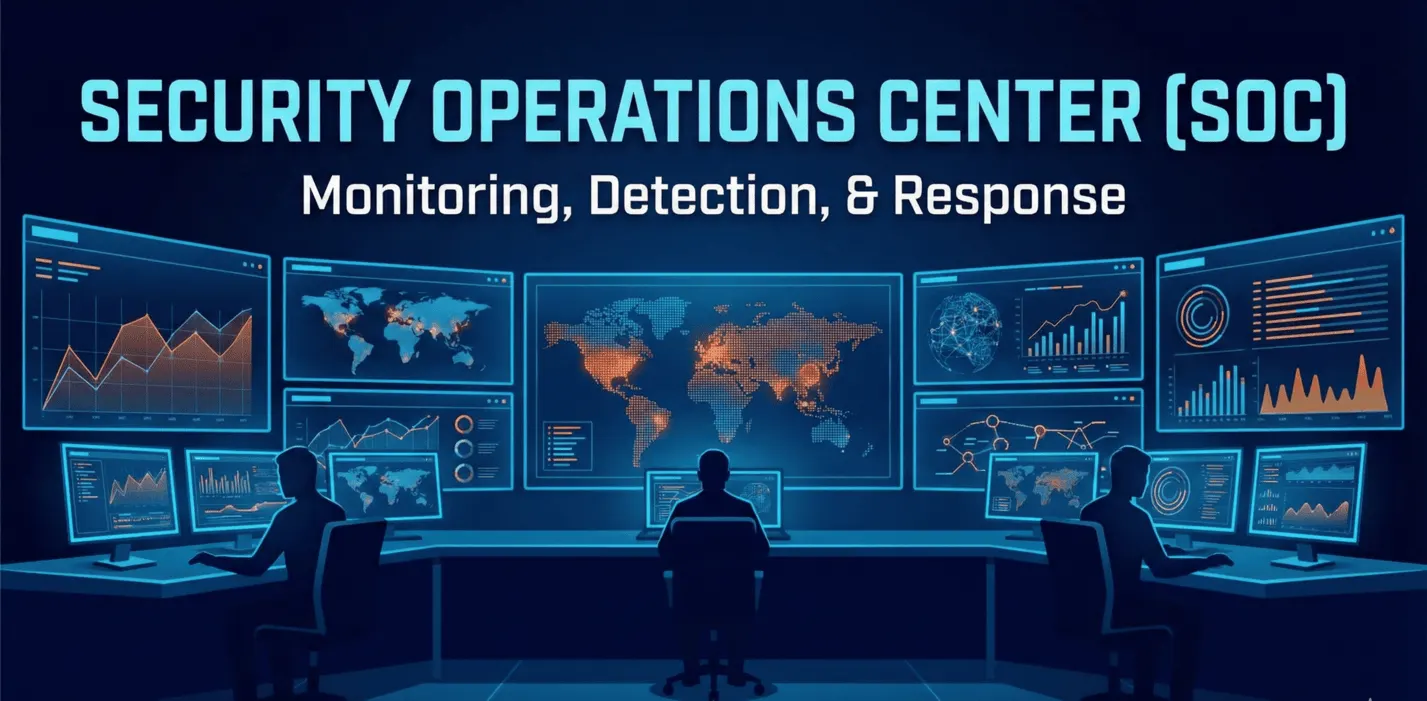
Today's cyber threats change constantly, and the traditional approach to defense no longer works. Digital transformation, cloud computing, remote work, the Internet of Things (IoT), and complex supply chains have broken up the old boundaries of corporate IT. The "castle and moat" model, where the firewall was the perimeter and everyone inside was safe, can't stop modern threats.
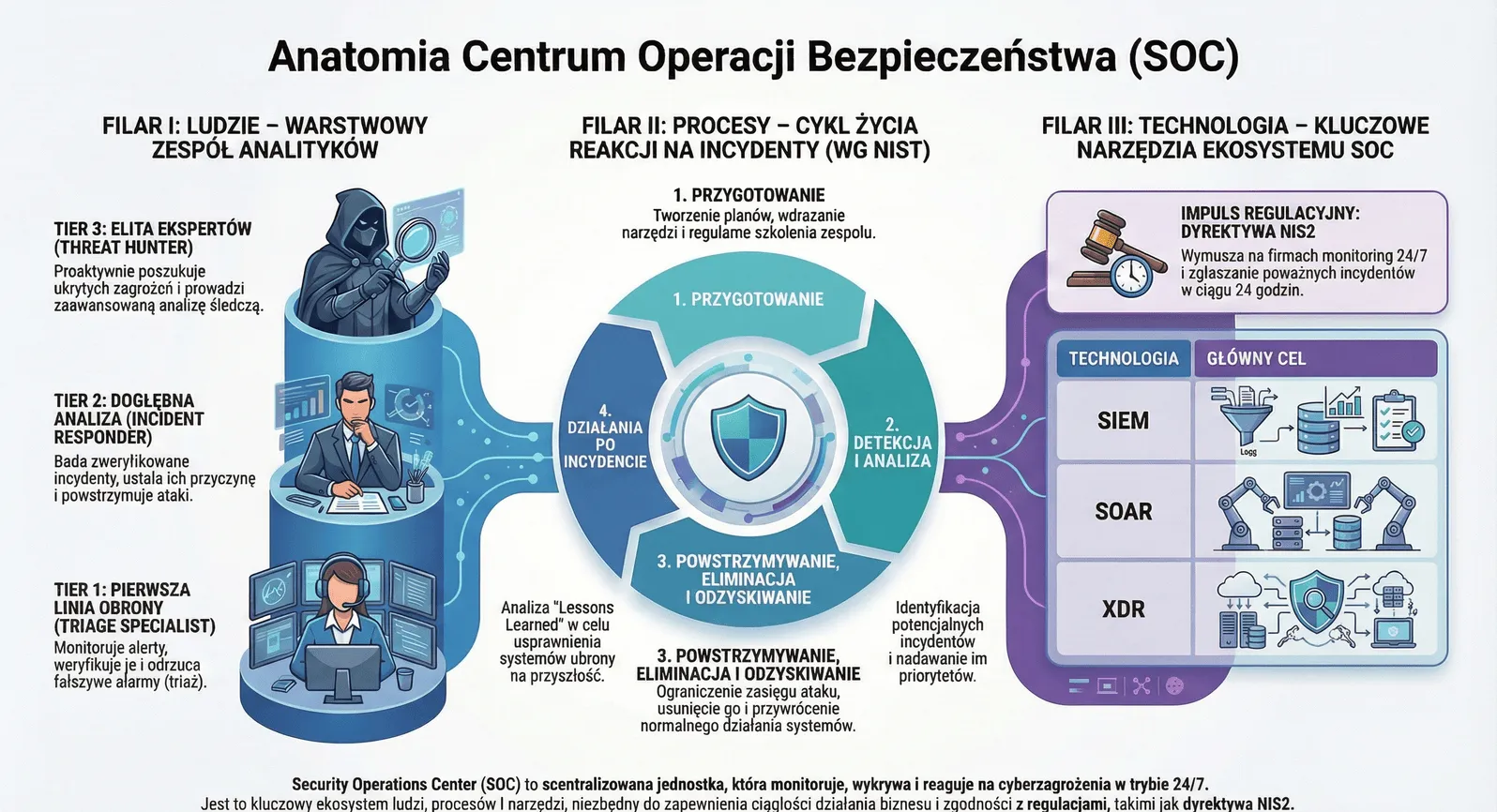
The answer is the Security Operations Center (SOC): a centralized operational unit at the core of a modern defense strategy. A SOC combines people, processes, and technology into one system. Its job is to provide continuous visibility, detection, and real-time incident response, 24/7/365.
This article covers the whole picture of a modern SOC: team structure and the psychology of analysts, the technology involved, the regulatory requirements of the NIS2 Directive, and where AI is taking security operations.
A Security Operations Center is a physical or virtual facility where a team of cybersecurity experts continuously monitors, detects, analyzes, and responds to security incidents. A SOC is more than a "fire department" that puts out fires once they start. Modern SOCs are becoming proactive risk management hubs. They use advanced analytics and Cyber Threat Intelligence (CTI) to anticipate attacks before the adversary runs a single command.
People often confuse a SOC with a NOC (Network Operations Center). The two do fundamentally different jobs:
Cybercriminals are getting more aggressive, and regulations such as NIS2 are raising the bar. As a result, the SOC has become a key part of business continuity. Without one, a ransomware attack or major breach can simply shut an organization down. A SOC is no longer a luxury for the largest banks. Every digital organization needs one to survive.
The biggest threat to SOC effectiveness isn't a lack of technology. It's the burnout of the analysts on the front line. You can own the most expensive software in the world, but without skilled, motivated people it's just a very expensive screensaver.
Most SOCs use a tiered organizational structure (Tier-Based Model). It splits responsibilities and defines how incidents are escalated, which makes thousands of alerts a day manageable.
Every alert from the monitoring systems lands here first. Tier 1 analysts are the "infantry" of cybersecurity.
Responsibilities:
Challenges:
The biggest risk: alert fatigue
The key danger here is alert fatigue. Analysts flooded with thousands of notifications a day, most of them irrelevant, stop paying close attention. That sharply raises the risk of missing the one critical incident that could bring the whole organization to a halt.
When Tier 1 decides something needs a closer look, the incident is escalated to Tier 2. These specialists have deeper technical knowledge and more autonomy.
Responsibilities:
Actions:
These are the best of the best. Tier 3 analysts don't wait for alerts. They work on the assumption that a sophisticated adversary may already be inside the network, hidden from automated detection systems.
Responsibilities:
Role:
A SOC manager has to work in both the technical and the business world. They are responsible for:
Industry data is worrying:
70% of SOC analysts report symptoms of burnout, and many plan to change jobs within the next year.
Causes:
Strategic consequences:
Solving the staffing crisis comes down to four things:
Many people believe a SOC mostly responds to active attacks, or "fights fires." In reality, how well a security operations center performs depends mostly on work done long before any incident is detected.
The core process framework in every mature SOC is the incident response life cycle defined by NIST. It has four main phases:
It may seem counterintuitive, but SOC effectiveness rests on preparation, not response.
Key elements of the preparation phase:
1. Asset Management
2. Tool Deployment and Configuration
3. Building Playbooks (Procedures)
4. Training and Tabletop Exercises
Containment:
Eradication:
Recovery:
A mature SOC spends most of its time on proactive preparation, refining procedures, and strengthening defenses, not on reacting in crisis mode.
Owning the newest, most expensive security tools doesn't guarantee protection. Technology becomes a trap unless it is part of a larger plan that includes skilled people and defined processes.
The technology core of a modern SOC rests on three pillars: SIEM, EDR/XDR, and SOAR. Each plays a different, complementary role.
Functions:
Correlation example: A SIEM can link a failed VPN login to an unusual permission change in a database and raise the alarm: "We have a problem!" That's how it spots a potential privilege escalation attack.
Drawbacks:
EDR (Endpoint Detection and Response):
XDR (Extended Detection and Response) – "EDR on Steroids":
SOAR is the technology that rescues analysts. It automates repetitive manual tasks and integrates ("orchestrates") separate tools so they work as one system.
Sample phishing automation workflow:
Benefits:
| Feature | SIEM | SOAR | XDR |
|---|---|---|---|
| Primary Goal | Log management, compliance, historical analysis | Automation, orchestration, case management | Integrated real-time detection and response |
| Data Source | All logs (broad coverage) | Alerts from other systems | Sensor telemetry (deep context) |
| Role in the SOC | Analytical "memory" and "brain" | Executing "hands" | "Next-gen" operational detection platform |
| Relationship | Alert source for SOAR | Executes actions for SIEM/XDR | Often replaces SIEM for detection, but not for compliance |
Technology is useless without skilled people to run it and defined processes (playbooks) to direct it.
SOAR is the glue that lets people and processes get the full value out of SIEM and XDR. It solves the information overload problem that directly drives analyst burnout.
How to deploy a SOC isn't a technical question. It is one of the most important strategic and financial decisions an organization makes.
Recommended reading: Looking for detailed numbers? See our new analysis: SOCaaS or an In-House Team? A Detailed Cost and ROI Analysis (2026 Edition).
Description: Building your own security operations center from scratch.
Advantages:
Disadvantages:
Best for: Large organizations with very specific requirements (e.g., government agencies, large banks), or entities that can't outsource security functions for regulatory reasons.
Description: Outsourcing monitoring and incident response to a specialized provider (MSSP, Managed Security Service Provider).
Advantages:
Disadvantages:
Best for: Small and midsize businesses, organizations without the budget for their own SOC, and companies that need to meet compliance requirements quickly (e.g., NIS2).
Description: An in-house team working together with an outside provider.
A typical split of responsibilities:
Advantages:
Disadvantages:
Best for: Midsize organizations that want to keep control but don't have the budget for a full in-house 24/7 SOC.
Most companies shouldn't build their own 24/7 SOC from scratch. A hybrid or managed model is often the most balanced choice: you keep control while lowering costs and protecting your team.
A SOC capability is no longer optional. For thousands of Polish companies, it is now a legal obligation.
Poland is implementing the EU's NIS2 (Network and Information Security 2) Directive by amending the National Cybersecurity System Act (KSC). The new rules fundamentally change how cybersecurity works in Poland.
The new law splits regulated entities into two categories:
Essential Entities:
Important Entities:
An estimated several thousand Polish companies will be covered, far more than before.
A key change in NIS2 is its focus on supply chain security. Organizations are responsible for the cybersecurity of their key ICT suppliers, which extends their accountability beyond their own walls.
The biggest change concerns reporting significant incidents to the relevant national CSIRTs (CSIRT NASK, CSIRT GOV, and CSIRT MON):
The key point:
If a significant incident is detected on a Friday evening, over a weekend, or on a public holiday, an organization without round-the-clock monitoring has no chance of meeting the 24-hour deadline.
An organization with no analysts on duty at night or on holidays won't be able to meet this requirement, and it faces:
In this way, NIS2 effectively forces hundreds of Polish companies to run a SOC capability 24/7/365. That is a major operational and financial challenge, and it is pushing organizations to rethink their security model at a strategic level.
Atman, a leader in Poland's data center market, is an example of successful NIS2 adaptation. To meet the new regulatory requirements, the company deployed a SOC service built on the SecureVisio platform (SIEM/SOAR). The goals: real-time risk analysis, automated response, and full compliance, while keeping costs under control.
The traditional "number of closed tickets" metric isn't enough to judge how well a SOC works. A modern security operations center should be measured by metrics that actually translate into lower business risk.
What it measures: How quickly the SOC detects an active threat after it appears.
Why it matters: The faster the detection, the less time an adversary has to exfiltrate data or spread through the network.
Goal: Drive MTTD down with advanced analytics, CTI, and threat hunting.
What it measures: How quickly the SOC responds to a detected threat and neutralizes it.
Why it matters: Ransomware can encrypt an entire network within hours, so response time has to be measured in minutes, not hours.
Goal: Automate response with SOAR to cut MTTR to a minimum.
What it measures: How long an advanced adversary (APT) stayed in the network undetected, from initial compromise to detection.
Why it matters: The longer the dwell time, the more likely it is that data has been stolen, backdoors installed, and the compromise has spread deeper.
Industry benchmark: Reports put the global average dwell time at several dozen days. Mature SOCs aim to bring it down to a few days or even hours.
What it measures: The percentage of system-generated alerts that turn out to be false positives.
Why it matters: A high false positive rate leads directly to alert fatigue and analyst burnout.
Goal: Keep tuning SIEM rules and use XDR/AI to reduce false alarms.
What it measures: The percentage of incidents fully closed (investigation, containment, eradication, recovery) within a set time frame.
Why it matters: It shows whether the incident response process is being completed end to end.
The future of security operations is autonomy. The idea behind the autonomous SOC is that artificial intelligence (AI) and hyperautomation will take over most of the tasks Tier 1 and Tier 2 analysts handle today.
What AI will take over:
Intelligent AI agents will independently:
Does this mean the end of jobs for people? Quite the opposite.
The human role in the SOC is moving toward tasks where people are irreplaceable:
The technology is changing, and so is the organizational model. A Cyber Fusion Center is built around:
Bringing experts from different domains together in one place:
Benefits:
Example: An attempt to get into the server room without authorization (physical security) happens at the same time as a brute-force attack on administrator accounts (cybersecurity). Correlating the two reveals a coordinated insider threat or physical penetration attack.
The future of the SOC combines human creativity, strategic thinking, and ethical judgment with the speed, scale, and precision of artificial intelligence.
The Security Operations Center is no longer a tech toy for the wealthiest corporations. Given how aggressive today's cybercriminals are, regulations like NIS2, and the inevitable rise of AI, a SOC is now essential to the survival of every digital organization.
The biggest threat isn't a lack of technology. It's the burnout of the people on the front line. Alert fatigue undermines even the best-equipped SOC.
The best defense is built before the attack, not during it. Preparation is the most important phase of the incident life cycle.
Technology without people and processes is a trap. SIEM, XDR, and SOAR are powerful tools, but how well they work depends entirely on skilled analysts and well-defined playbooks.
Building your own 24/7 SOC is a multimillion-dollar decision, and most companies shouldn't rush into it. A hybrid or managed model is often the most balanced choice.
NIS2 effectively requires thousands of Polish companies to run a SOC capability 24/7/365, with fines of up to EUR 10 million or 2% of turnover.
The future is autonomy. AI takes over routine tasks, and people focus on strategy, threat hunting, and managing algorithms.
With these challenges and trends in mind: is your organization's approach to security a relic of the past, or is it ready for a future that has already arrived?
Whether you build a SOC yourself, hire an outside provider, or choose a hybrid model, one truth stays the same:
Technology isn't what matters most. The people and processes that run it are.
If you're considering a Security Operations Center for your organization or want to improve your existing security processes, contact us. We'll help you choose the right solution for your budget and regulatory requirements.
#SecurityOperationsCenter #SOC #Cybersecurity #InformationSecurity #NIS2 #SIEM #XDR #SOAR #ThreatHunting #IncidentResponse #ManagedSOC #SOCaaS #CyberThreatIntelligence #AlertFatigue #MTTD #MTTR #SecurityManagement #DataProtection #Compliance
A Security Operations Center (SOC) is a centralized unit that continuously monitors, detects, analyzes, and responds to cybersecurity incidents 24/7/365. It brings people (security analysts), processes (playbooks and procedures), and technology (SIEM, EDR, XDR, SOAR) together into a single protective system.
A SOC (Security Operations Center) focuses on security: detecting threats, anomalies, and cyberattacks. A NOC (Network Operations Center) handles network performance and availability: uptime, bandwidth, and infrastructure monitoring. The SOC hunts for adversaries; the NOC keeps systems performing.
A 24/7 in-house SOC needs at least 10–12 full-time positions (covering shifts, vacations, and training), which costs at least several million PLN a year. On top of that come software licenses (SIEM, EDR, XDR, often USD 100,000–500,000 per year), infrastructure, and physical space. That's why most companies choose a managed SOC (SOCaaS) or a hybrid model.
A managed SOC, also called SOCaaS (SOC as a Service), is an outsourced security operations center. A specialized provider (MSSP) delivers 24/7 monitoring, incident response, and access to experts on a subscription basis. Deployment takes weeks rather than months, and costs are much lower than running your own SOC.
The key technologies are:
Alert fatigue happens when analysts get thousands of notifications a day, mostly false alarms, and start losing focus and ignoring alerts. As a result, critical incidents get missed. Research shows that 70% of SOC analysts experience burnout, which is the biggest threat to a SOC's effectiveness.
Threat hunting is the proactive search for threats carried out by Tier 3 analysts. Instead of reacting to alerts, threat hunters assume a sophisticated adversary is already in the network but hidden from automated systems. They use advanced analysis techniques, forensics, and intuition to find hidden threats.
Poland is implementing NIS2 by amending the National Cybersecurity System Act (KSC). Essential and important entities must report significant incidents within 24 hours (early warning) and 72 hours (full notification). In practice, this requires 24/7/365 monitoring, because those deadlines can't be met without it. Fines reach EUR 10 million or 2% of annual turnover.
A hybrid model combines an in-house team with services from an outside provider. Typically, an external MSSP handles 24/7 Tier 1 monitoring (especially nights and weekends), while the in-house team (Tier 2/3) handles advanced analysis, threat hunting, and strategy during business hours. It's a cost-effective approach that also protects your own experts from burnout.
SIEM is a security event management system. It collects logs from all sources, correlates them, and generates alerts. It's excellent for compliance and historical analysis but produces many false alarms. XDR (Extended Detection and Response) is an integrated platform that combines telemetry from endpoints, network, cloud, and identity. Its deeper context gives it higher-quality alerts and fewer false positives. XDR often replaces SIEM for detection, but not for compliance.
It depends on the model:
These are the key KPIs for measuring SOC effectiveness. SOCs also track dwell time (how long an intruder stays in the network undetected) and the false positive rate (the percentage of alerts that are false alarms).
Yes, especially with NIS2 in force. But small and midsize businesses should not build their own SOC, because of the cost (millions of PLN per year) and the difficulty of hiring. The best options are:
Read more
SOC analysts are drowning in false alarms. Here's how SOAR playbooks and agentic AI cut response times from hours to seconds and help end alert fatigue.
SIEM or XDR? Compare logs vs. telemetry, the true TCO, and see why a hybrid SIEM + XDR model may be the best fit for your SOC in 2025.
It's not if but when. Build an NIS2-ready incident response plan: 24/72h reporting, CSIRT roles, ransomware playbooks and tabletop exercises.
A free consultation with one of our experts — no obligation, in full confidence.
Let's talkWe'd like to use Google Analytics cookies to see how many people visit the site and which content is useful. We'll only set them if you agree. You can change your decision at any time via the “Cookie settings” link in the footer. Cookies Policy