Cyberattacks Up 48% in September 2026, Europe Up 61%: Check Point Report
Check Point: cyberattacks rose 48% year over year in September 2026 and 61% in Europe, with ransomware up 53%. Key takeaways for businesses.
Analysis
Why did RAM prices skyrocket in 2025? It's not just AI. Inside the silicon physics, Samsung's strategy and the end of Windows 10.
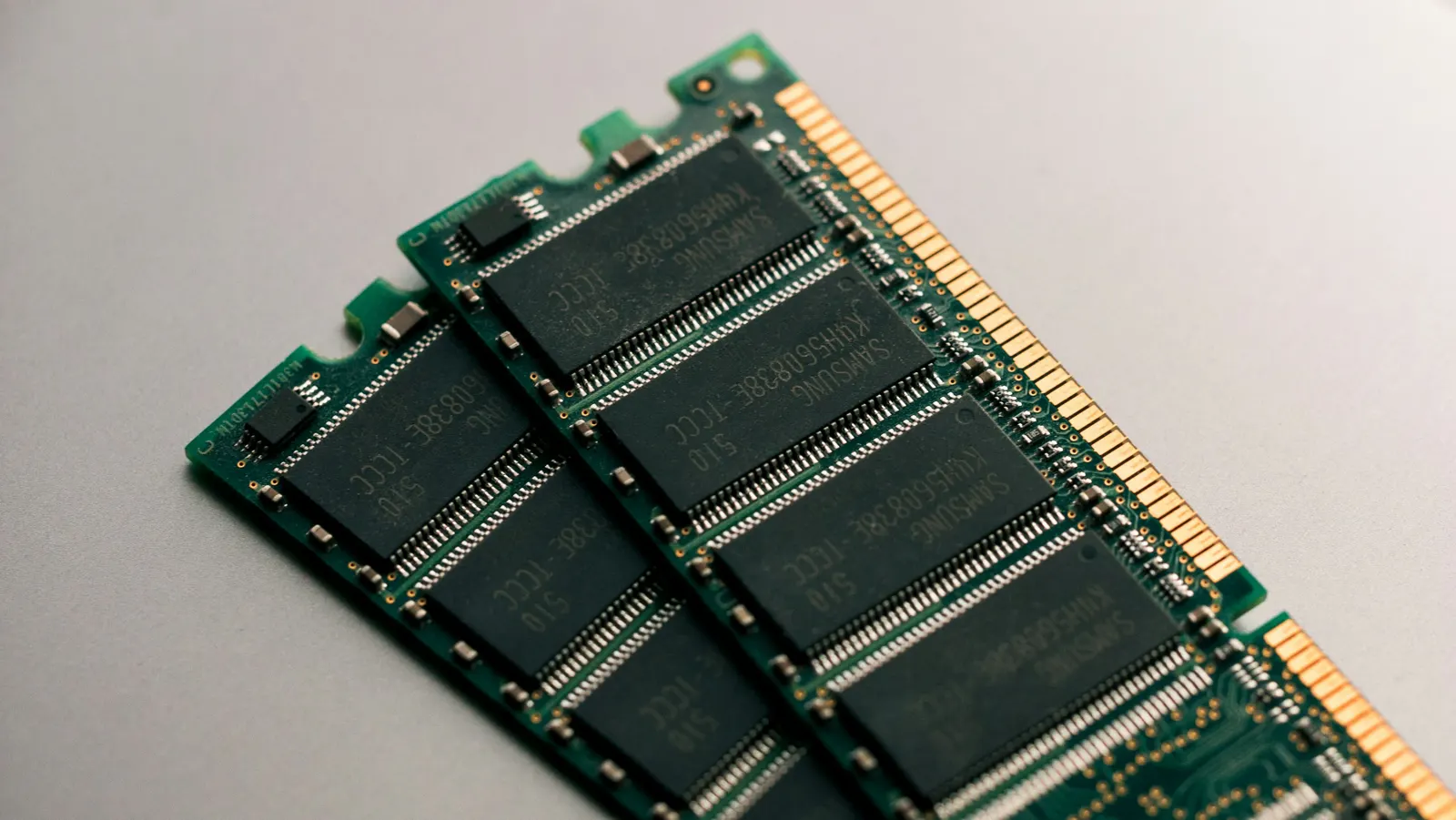
If you planned to "add a bit more RAM" in 2025 to breathe new life into your desktop, you probably hit a wall. A reinforced-concrete one. Memory, for years the cheapest way to speed up a computer, has suddenly become a luxury item.
A 64 GB kit that costs about as much as a gaming console? That's our painful new reality.
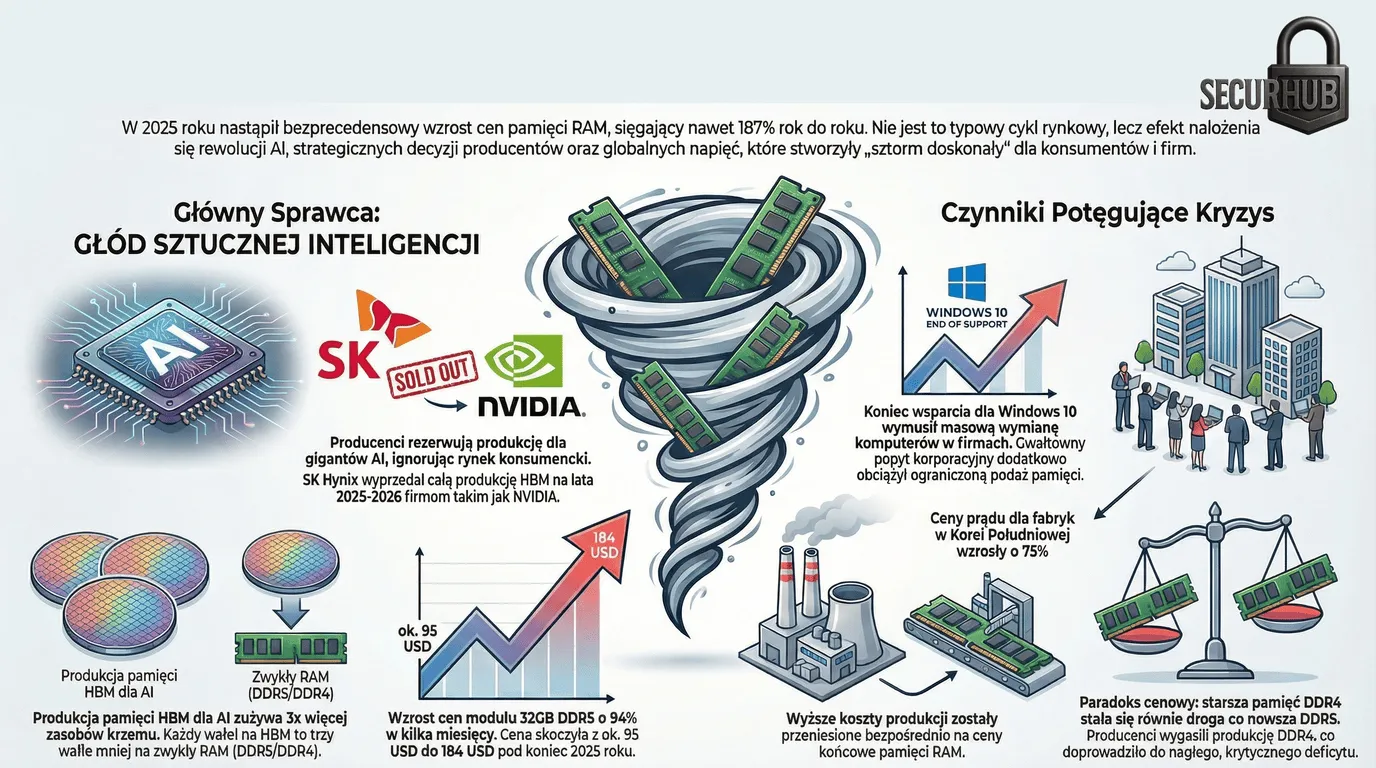
It's easy to say "blame AI" and leave it there. The real story is more complicated. It's a set of interlocking forces where silicon physics meets corporate calculation and global politics. Let's look at the five "horsemen of the apocalypse" of the memory market, the ones people rarely talk about.
Let's start with the fundamentals. In semiconductors, you can't cheat physics. Everyone knows NVIDIA needs huge amounts of memory for its AI accelerators. Far fewer people realize what that production costs in physical terms.
HBM (High Bandwidth Memory), the type used for AI, isn't made of ordinary chips laid out flat. It's built like silicon skyscrapers: multi-layer stacks connected by vertical tunnels.
Key takeaway: Producing the same capacity with HBM uses roughly three times as much silicon wafer area as standard RAM.
Put simply, every silicon wafer set aside for AI effectively means three wafers that didn't become memory for your computer. Production capacity is being cannibalized on an unprecedented scale. SK Hynix has sold out its capacity years in advance, which removes a huge share of supply from the consumer market. This isn't greed. There's simply no room left on the production line.
In normal times, we'd count on Samsung, the giant that floods the market with product and drives prices down. But 2025 is not a normal year. Samsung struggled to produce HBM efficiently (and earned thin margins of around 30% on it), so it made a surprising pivot.
Instead of coming to the rescue of gamers and everyday users, the company moved massive capacity (an estimated 80,000 wafers per month!) to producing RDIMM server memory.
Why? Pure business math. The AI frenzy also created a shortage in data centers, pushing margins on RDIMM modules to an astronomical 75%. Samsung made a strategic arbitrage play: it gave up the consumer market to earn a fortune from enterprises. The decision looks great in a spreadsheet. It looks terrible in consumers' wallets.
This may be the most counterintuitive point on the list. "Old" hardware usually gets cheaper. Yet in 2025, prices of aging DDR4 memory started catching up with brand-new DDR5. How is that possible?
It's a classic supply shock.
The result? Supply vanished while demand stayed put. DDR4 prices, which bottomed out in March (USD 25), shot up to USD 85 within a few months. It's a harsh lesson for companies running older infrastructure: putting off upgrades just got very expensive.
Hardware isn't the only culprit. A date has quietly killed low prices: October 14, 2025, when support for Windows 10 ends.
For enterprises, running without security patches is an unacceptable risk. Rather than paying Microsoft a "ransom" for extended support (whose price doubles every year), companies went on a buying spree.
The global PC market has come back to life, but new "AI PC" machines aren't satisfied with 8 GB of RAM anymore. 16 or 32 GB is becoming the standard. This forced replacement cycle works as a multiplier: more computers are sold, and each needs several times more memory than the one it replaces. It's pouring gasoline on the fire.
Finally, the factor we forget most often. A chip is, in essence, electricity frozen into silicon. Semiconductor manufacturing uses staggering amounts of energy.
In South Korea, industrial electricity prices rose by 75% over four years. That cost has to be passed on to customers. Add the US-China trade war and tariffs that raise import prices by another 20–50%, and you get a hard price floor. Even if demand fell, production and logistics costs wouldn't let prices return to where they were a few years ago.
We're in a perfect storm. The consumer market has in effect been made to subsidize the artificial intelligence revolution. Every dollar we overpay for RAM today funds the AI and server arms race.
Experts are clear-eyed: the days of cheap memory are over. Relief may not come until around 2027, when new fabs come online. I'll leave you with a question worth asking as you look at store prices:
Are we watching the moment when the PC became "collateral damage" of the AI era, and high component prices became a new, permanent "tax on progress" that we'll be paying for years?
Aleksander
RAM prices soared because five factors came together (a "perfect storm"):
The short answer: not anytime soon. Hardware market analysts expect high RAM prices to persist throughout 2025, with possible price cuts arriving no earlier than the first half of 2026. Waiting for prices to bottom out is risky right now because of volatile energy costs and the priority given to HBM production for AI. If you need the performance now, buy now.
It depends on the size of the upgrade. Because DDR4 and DDR5 prices have converged (a pricing anomaly), putting a lot of money into an old DDR4 platform makes no economic sense. It only pays off for small upgrades, such as buying used modules. If you're building a new computer or planning a major memory expansion (for example, to 64 GB), DDR5 is the only future-proof choice.
The standards have changed. In the age of "AI PCs" and Windows 11, 16 GB of RAM is the bare minimum for basic office work and older games. For smooth gaming, video editing and multitasking, 32 GB of RAM is the new standard (the sweet spot). Keep in mind that modern background apps use far more resources than they did just two years ago.
Read more
Check Point: cyberattacks rose 48% year over year in September 2026 and 61% in Europe, with ransomware up 53%. Key takeaways for businesses.
Tesla's Mixed-Precision Bridge patent application brings 32-bit AI precision to cheap 8-bit chips. What it means for FSD, Optimus and edge AI.
Can AI have trauma? Researchers put ChatGPT, Gemini and Grok through therapy sessions. The result: synthetic psychopathology and a new jailbreak risk.
A free consultation with one of our experts — no obligation, in full confidence.
Let's talkWe'd like to use Google Analytics cookies to see how many people visit the site and which content is useful. We'll only set them if you agree. You can change your decision at any time via the “Cookie settings” link in the footer. Cookies Policy