
Threat Hunting: Why Your Network Needs a Hunter, Not Just a Guard
Traditional security waits for a breach. Threat hunting goes looking for it. Learn why controlled paranoia is the healthiest strategy for your business.
Cybersecurity
Eight critical Chrome zero-days in one year. How APT groups weaponized the V8 engine, and why the sandbox alone is no longer enough in 2025.

In 2025, Google fought a steady battle against zero-day vulnerabilities in Chrome. Over the year it fixed eight critical vulnerabilities that attackers were already exploiting in the wild. Every one of them was rated high severity, with an average score of 8.5 on the CVSS scale.
Attackers were this active, including state-sponsored groups and companies that sell commercial surveillance tools, because Chrome is still the main target of advanced cyberattacks worldwide.
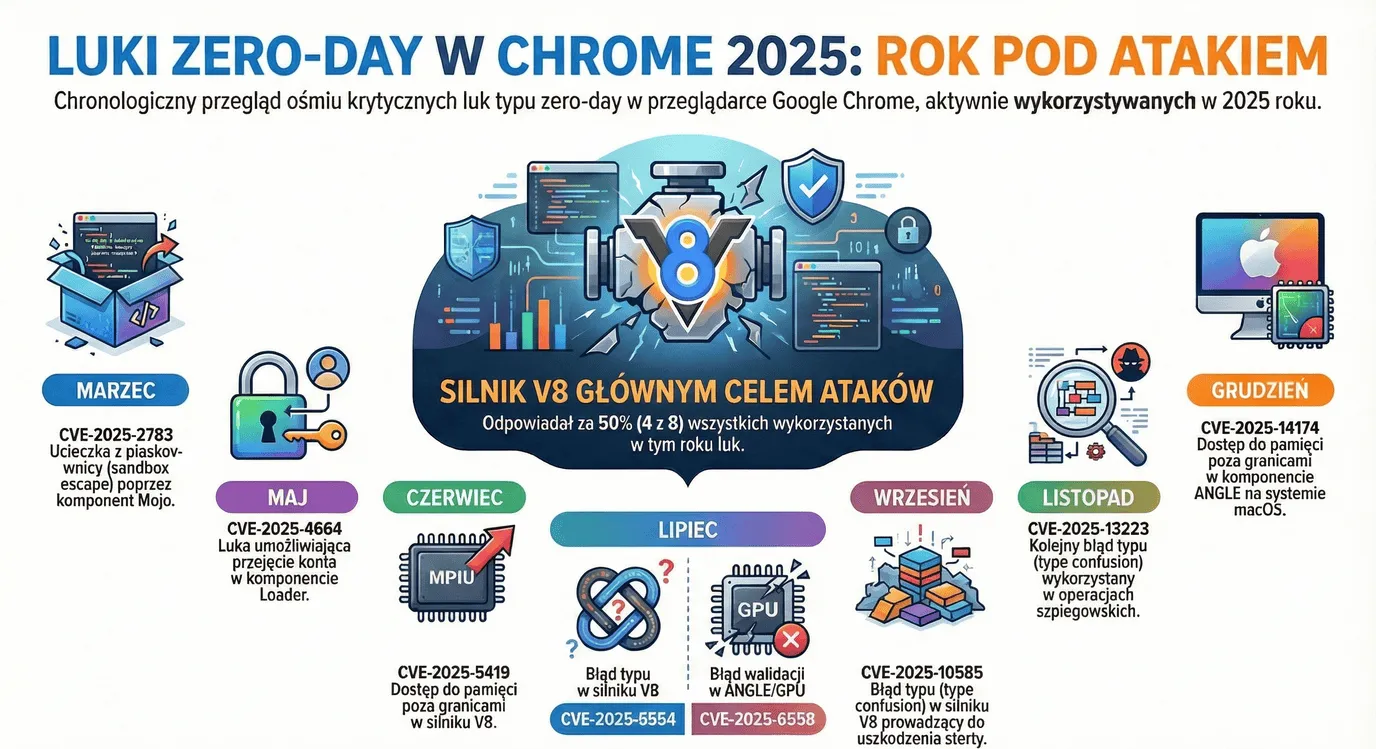
The attacks focused on the browser's core components: the V8 JavaScript engine, the sandbox protections, and the graphics components. All of these incidents are listed in CISA's official catalog.
| CVE ID | Discovered | Component and Bug Type |
|---|---|---|
| CVE-2025-2783 | March | Sandbox escape |
| CVE-2025-4664 | May | Unauthorized account takeover |
| CVE-2025-5419 | June | Memory access bug in V8 |
| CVE-2025-6554 | July | V8 engine flaw |
| CVE-2025-6558 | July | Unspecified bug |
| CVE-2025-10585 | September | V8 type confusion |
| CVE-2025-13223 | November | V8 type confusion |
| CVE-2025-14174 | December | Vulnerability in the ANGLE module / GPU handling |
The V8 engine was the weakest link. Most of the flaws found there, such as CVE-2025-10585, were "type confusion" bugs. These let attackers trick the engine into misreading data, which ultimately lets them run malicious code remotely (RCE) on the user's computer.
The March vulnerability CVE-2025-2783 was especially dangerous. It let malware "escape" the browser's isolated environment and gain direct access to the operating system's files and functions.
Toward the end of the year, attackers turned their attention to the ANGLE graphics layer and the Mojo IPC communication system. For example, CVE-2025-14174 allowed attackers to manipulate the memory of the processes that render images on screen.
Experts point to two main groups of threat actors:
In the high-profile "ForumTroll" operation, attackers used a Chrome vulnerability to infect their targets with the advanced LeetAgent trojan.
Operation ForumTroll was one of the most sophisticated espionage campaigns of 2025, and it showed in practice how powerful CVE-2025-2783 was. The attack, attributed to state-backed APT groups, targeted educational institutions and media organizations and used an unusual approach to exploiting systems.
The most dangerous part of the operation was its ability to bypass Chrome's protections completely. Researchers at K7 Security Labs reported that a logic flaw at the boundary between Chrome and Windows let the attackers escape the browser sandbox "as if it didn't exist at all."
The infection had two stages:
The attackers took great care with operational security (OpSec) to avoid detection by monitoring systems:
primakovreadings[.]info).The main purpose of the deployed malware (detected under names including Trojan.Win64.Agent) was to steal sensitive information. The malware:
Protection status: Google patched this vulnerability on March 25, 2025, in Chrome version 134.0.6998.177/.178. The incident remains a strong argument for deploying remote browser isolation (RBI) in critical infrastructure.
Google keeps adding new protections such as MiraclePtr, but Chrome is so widely used that it remains an attractive target.
Recommendations for organizations:
Read more
Traditional security waits for a breach. Threat hunting goes looking for it. Learn why controlled paranoia is the healthiest strategy for your business.
CVE-2026-88779 in SAML-enabled NetScaler ADC and Gateway was exploited before a patch. Attackers inject commands via the username field. Patch now.
CVE-2026-104286 (CVSS 9.8) lets unauthenticated attackers write arbitrary files on FortiMail and is actively exploited. See patches and mitigations.
A free consultation with one of our experts — no obligation, in full confidence.
Let's talkWe'd like to use Google Analytics cookies to see how many people visit the site and which content is useful. We'll only set them if you agree. You can change your decision at any time via the “Cookie settings” link in the footer. Cookies Policy