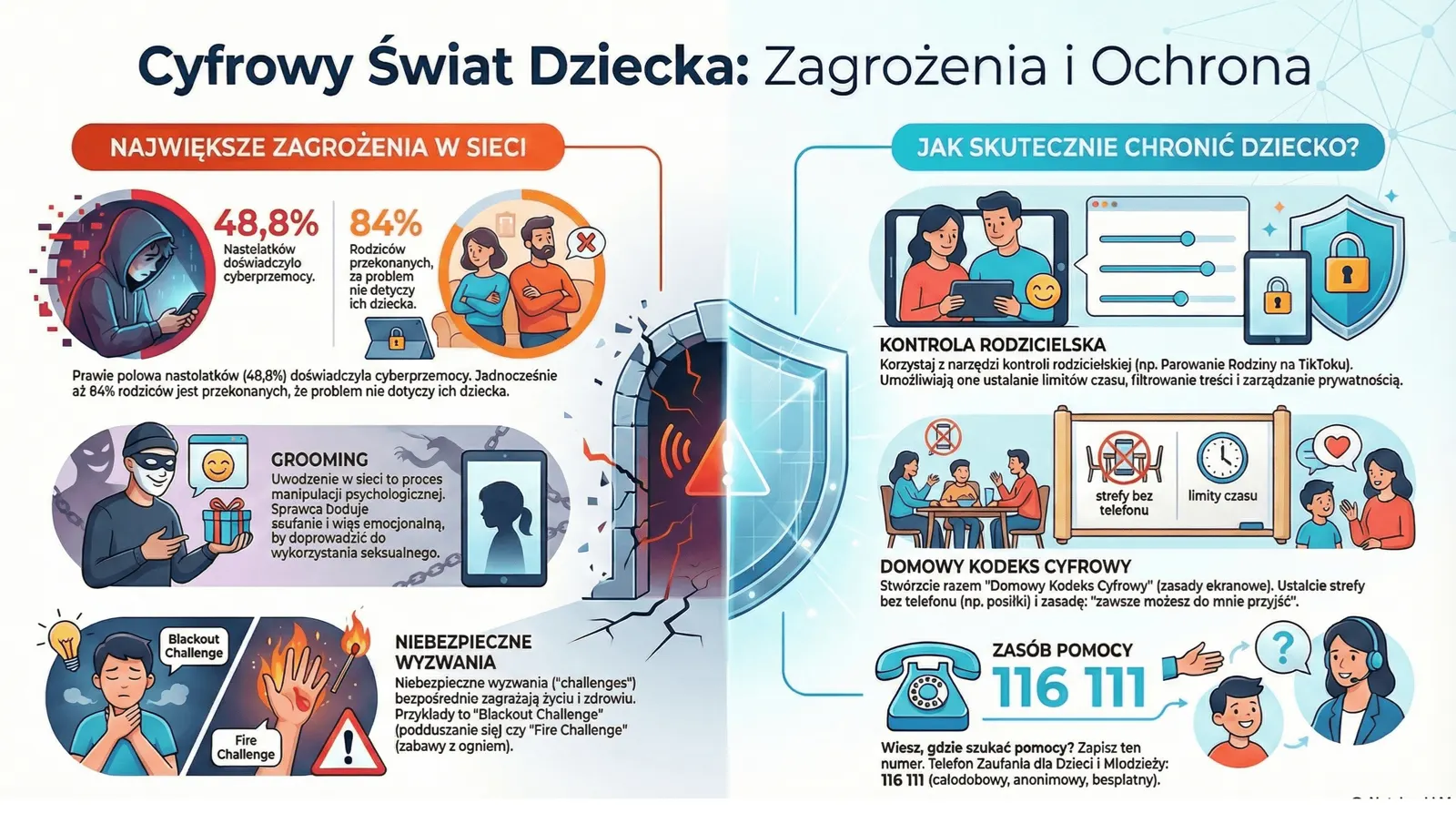
Kids Online in 2025: Patostreams, "Sleepy Chicken," and a Law That Punishes the Victims
Over 600,000 incident reports. We break down NASK and police data on deadly TikTok challenges, Roblox scams, and Poland's sexting legal trap.
Cybersecurity
Poland plans record spending to fight disinformation in 2026. Inside the government's strategy, from a huge awareness campaign to defending NASK.

Browsing the internet increasingly feels like pushing through a dense fog of conflicting messages, false alarms and deliberately manipulated content. Telling truth from lies has become hard for all of us, and governments can no longer stand by. Poland's government, speaking through Deputy Prime Minister and Minister of Digital Affairs Krzysztof Gawkowski, is announcing an unprecedented offensive. In 2026, Poland plans to bring out its heaviest weapons against disinformation. What exactly is behind this declared "war," and which tools will be used to fight it?
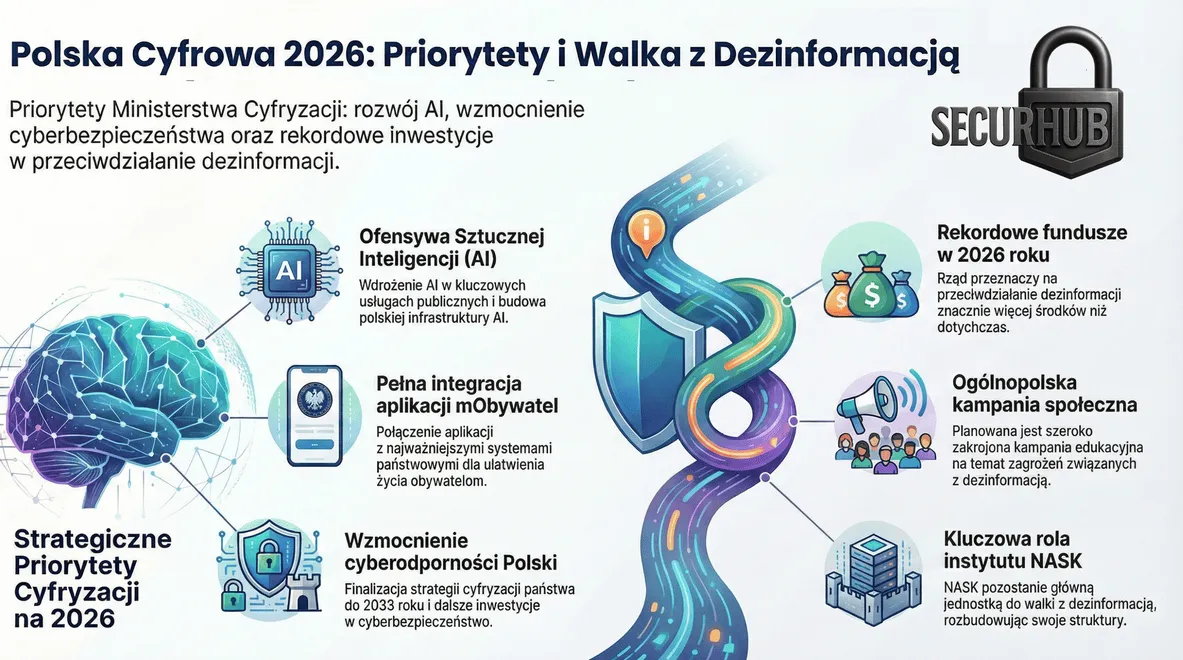
Deputy Prime Minister Gawkowski's statement that 2026 will be a "record year in terms of spending on countering disinformation" is far more than a budget update. It is a strategic signal that protecting the information space is becoming one of the state's top priorities. The government plans to commit "much more funding" to the effort than this year, which shows how big the coming push will be.
According to the minister, the strategy will rest on two main pillars:
This marks a significant change in approach. The shift from reactive "digital firefighting" to proactive "social inoculation" reflects an understanding that technical safeguards alone are not enough. The human factor has become the main battlefield of the information war. The plans also reach beyond the Ministry of Digital Affairs. As the minister noted, a dedicated unit within the Ministry of Foreign Affairs is also being expanded. Poland is clearly treating the problem comprehensively, combining domestic, interministerial and diplomatic efforts. Much of the plan will be carried out by an institution that recently came under international criticism itself.
The NASK National Research Institute (NASK stands for Research and Academic Computer Network) is a key player in Poland's system for fighting disinformation and online threats. Its role is fundamental, but it has not been free of controversy, which makes its position especially interesting given the investments ahead.
On one hand, an OSCE report on NASK's activities during the most recent elections noted "concern" among observers. It found that the institute's public communication had been "delayed, inconsistent and non-transparent." This was a serious charge, and it called into question how transparent a key agency had been during a politically heated period.
On the other hand, Deputy Prime Minister Gawkowski has firmly defended the institute. In his view, NASK "has excellent competencies" and is doing "excellent work." He described its work under the so-called Election Umbrella (parasol wyborczy), an initiative to protect democratic processes from cyber threats and disinformation, as "well managed" and its results as "great successes." The government's unwavering defense of NASK despite sharp OSCE criticism suggests a political need to project strength and control over key cyber institutions. International criticism appears to count for less than continuity of the national strategy. The government even argues that NASK's experience, including the criticized parts, has become a valuable lesson for other countries. As a result, the institute will be strengthened, with further investment planned in its analytical and artificial intelligence teams.
Fighting disinformation is crucial, but it is only one part of a much broader digital transformation planned by the Ministry of Digital Affairs.
Focusing only on disinformation would be a mistake. The Ministry of Digital Affairs' plans for 2026 are in fact a comprehensive strategy to modernize the state. In that strategy, the fight for truth is closely tied to building modern public services and developing technology. The ministry's ambitions are broad and cover areas that will shape the country's future.
Here are the ministry's top priorities for 2026, as listed by Krzysztof Gawkowski:
This is more than a list of technology projects. It is the outline of a strategy for digital sovereignty. By developing its own AI models and semiconductor ecosystem, Poland aims to reduce its dependence on foreign tech giants, a key geopolitical move in an era of digital fragmentation. The government sees digitalization and resilience to disinformation as two sides of the same coin: building a modern, resilient state. Even plans this ambitious, however, run into real obstacles.
Everything suggests that in 2026 Poland is entering a decisive phase of its digital transformation. At stake are record funding and the political will to win the battle for truth in an increasingly complex information space. The plans are ambitious and the strategy appears comprehensive, combining public education with building advanced technological foundations for the state.
Still, as Deputy Prime Minister Gawkowski himself acknowledged, the pace of legislative work remains a challenge. He pointed to delays in implementing the EU Digital Services Act (DSA) as an example. He also suggested that the process is sometimes slowed by political factors, "including by the president." That raises a key question: can ambitious strategies and big budgets win the digital race when the pace of legislation and political realities are so unpredictable?
** Aleksander **
NASK (Research and Academic Computer Network) is a national research institute that serves as a center of expertise in cybersecurity and countering disinformation. It monitors the internet for false narratives, analyzes information threats and coordinates work under the so-called Election Umbrella, an initiative that protects the democratic process from cyberattacks and disinformation campaigns.
Deputy Prime Minister Gawkowski did not give a specific figure. He said only that it would be "much more funding" than this year and that 2026 would be a "record year in terms of spending on countering disinformation." Detailed amounts will be known once the 2026 state budget is passed.
The minister did not say what the planned "massive public awareness campaign" will include, or whether it will have a school education component. It is known, however, that the campaign will be wide-ranging. It will focus on raising public awareness of the threats posed by disinformation and on helping people learn to evaluate information critically.
Read more
Over 600,000 incident reports. We break down NASK and police data on deadly TikTok challenges, Roblox scams, and Poland's sexting legal trap.
A hacker tricked Anthropic's Claude and OpenAI's ChatGPT into helping steal 150 GB of Mexican government data. Here's how the AI jailbreak worked.
Mandatory KSeF is here. Learn how phantom invoices and fake tax office emails target Polish businesses, and how to protect your company from fraud.
A free consultation with one of our experts — no obligation, in full confidence.
Let's talkWe'd like to use Google Analytics cookies to see how many people visit the site and which content is useful. We'll only set them if you agree. You can change your decision at any time via the “Cookie settings” link in the footer. Cookies Policy